The Andrew Lees Trust logo

HIV Awareness Campaign


Since 2003, ALT has collaborated with the National HIV AIDS Awareness Committee of Madagascar (Commite Nationale Lutte contre le SIDA - CNLS)  to deliver HIV education and information via radio to rural populations in southern Madagascar ( see Projet Radio SIDA  below for more  details).

Download the ALT Project Radio SIDA Factsheet
In English (PDF 71Kb May 2008)

Download the Radio-SIDA Impact Evaluation

In English (PDF 51 Kb)

In French (PDF 51Kb)

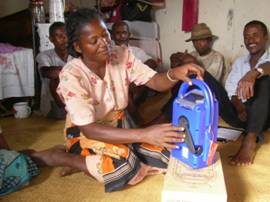
Within the last year, ALT has also distributed 2,000 radios for the CNLS across the Provinces of Toliara and Fianarantsoa, setting up dedicated listening groups who will received national broadcasts about HIV AIDS as well as locally produced radio programmes on the subject.

Currently, ALT’s own HIV AIDS radio campaign is being further developed under the auspices of the Drought Mitigation Programme. Funded by the Big Lottery, this work recognises the importance of empowering local people to protect themselves, and their efforts to develop a sustainable future, from the threat of the disease.

History


In November 2003 the Trust was introduced to the executive secretary of Madagascar's "Committee Nationale Lutte contre le SIDA" (CNLS) or National AIDS Committee.

On learning about the work of Projet radio in the south, the executive secretary immediately requested that ALT start to develop and broadcast HIV programming through its southern network.
Ambovombe formation

In January 2004 a six month pilot project was launched with the aim of developing targeted programming in local languages to increase awareness of HIV AIDS in the south of Madagascar. By June the project had developed 24 programmes that systematically developed HIV themes from the explanation of the virus, transmission and prevention, through to the promotion of local services which can support people with their enquiries and needs.

The project has taken a strictly participative approach researching local beliefs, sexual attitudes and behaviours, and traditional relationships such as ‘blood brothers’. The programmes have been made in local languages (Androy and Anosy) to ensure interest and understanding, were pre-tested with listening groups before broadcast and have also used local analogies to get the message across. For example:

Making Radio Programmes Work for Rural Listeners


Explaining complex medical issues to an illiterate audience is challenging – particularly in this region where traditional beliefs attribute illnesses to spirit possession. In order to provide a simple and accessible explanation to the rural population as to how the HIV virus attacks the body leading to AIDS, an early Projet Radio SIDA programme sought examples borne out of peoples’ daily lives. The programme used a simple analogy from local farming practice where fields are protected by natural fencing of local cactus plants – the raketa mena.

In the programme the raketa cactus is presented as Helper T-cells that fight off illness in the body, represented as a field, and insects representing the HIV virus.

This programme was comprised of a dialogue between two women speaking in local Antandroy dialect, where one woman explains how the insects (HIV virus) can ravage the cactus (antibody), causing subsequent damage to the field ( the body) which the cactus protects - as a consequence, subsequent opportunistic infections (represented by animals familiar to the region) can then enter and destroy the body.

Pre-testing at Ambanisarka. A group of three women listen to a tape. Outside the window, the cactus plants are seen protecting the plot.

Pre-testing was conducted prior to broadcast, and people were able to identify the key messages that arose out of the programme, as well as mentioning that the locale and communication format connected closely to their lives. In final evaluations in the villages, this analogy was the second-highest recalled programme in the Androy region. One village listening group commented:

"The broadcast [raketa cactus analogy] helped us a lot, especially when she took an example from our daily lives and she used the cactus, the field, and other enemies of our culture, and we really appreciated it."

Listening group in Ambani

As 95% of the local target groups are illiterate, they greatly appreciate simple explanations which help them to understand the level of risk. Early evaluation of the impact of the programme show that of people interviewed in the target areas over 50% are learning about HIV through radio programming.

The project has submitted a further proposal to continue developing the HIV themes for the next six months. Watch this space for project news and updates

The project is also bringing edutainment to the HIV southern programme…

SENSIBILISATION & SERVICES:
Projet Radio SIDA working with Population Services International


Projet Radio SIDA (PR/SIDA) teamed up with Population Services International (PSI) in May 2004 to support the musician Tonton Mazavafo on his music tour in the south of Madagascar. Tonton’s music repertoire highlighted social issues relevant to the region; health, lack of water, deforestation, famine, and issues on sexual health. His songs focused strongly on HIV/AIDS and precautionary measures that people can take when faced with this illness.

Population Services International donated 3,000 condoms to the tour, and the Projet Radio SIDA team worked in cooperation via kiosks with demonstrations and distribution. A handout created by the Projet Radio SIDA team with HIV/AIDS facts, including the means of transmission, prevention and where to go for further information, worked in conjunction with PSI. The handout was translated entirely into the Antandroy dialect for the regional tour.

Partnerships such as this strengthened all parties involved, where people can receive strong information messages with the support of services to strengthen positive behaviour change.

A young man, aged 18, attending the concert remarked to the Projet Radio SIDA team "I didn’t believe in HIV/ AIDS before today. But after talking with you and getting this, [handout and condom leaflet] I believe it now".

Lemur© The Andrew Lees Trust 1995 - 2010