The Andrew Lees Trust logo

Food Security - APEMBA SOA


WORKING TO MITIGATE THE EFFECTS OF DROUGHT AND IMPROVE NUTRITION IN SOUTHERN MADAGASCAR


ALT’s ‘Apemba Soa’ Project (AS) - meaning 'Good Sorghum' - is funded by the European Commission and builds on the Drought Mitigation Programme (DMP) funded by the Big Lottery from December 2005 to May 2009.

The principle objective of the project is to improve food security by increasing the production of drought resistant sorghum as well as the number of households stocking and consuming sorghum as food.  Additionally the project undertakes to increase awareness about the nutritional benefits of sorghum by providing cooking and preparation techniques which enable women to improve daily intake of food.

Context


The south of Madagascar is located south of the equator and is the hottest and driest part of the island. The  project area, the Androy, is classified as Tropical Semi-Arid and Tropical Dry (SAP). Fluctuating rainfall patterns result in the majority of the communes receiving between 400-600mm a year, while the southernmost coastal communes targeted by this project receive less than 400mm annually.

The dry spiny forest of the south, a priority conservation zone, is host to unique endemic succulents and species that survive on very little water. However, An estimated 10,000 hectares of the unique spiny forest of the south is lost annually, mostly because of charcoal production for urban areas.  The cost of environmental degradation, principally from soil erosion, silting, and declining soil fertility and loss of forests has been estimated to be 5-15 % GDP annually.

Almost two million people live across the southern Province of Toliara which stretches between Ft Dauphin and Tulear, and the population is growing at a rate of 3.62% per annum. At least 75% of these populations are illiterate, rural producers living below the poverty line.

Target Zones of the Project


57% of the population (626,204) in the south are Antandroy, the majority are agro-pasturalists engaged in subsistence activities centred on raising livestock and cultivating maize and manioc.

With an average of 400-600mm annual rainfall (SAP) the region’s already low and sinking water table means that accessibility to water is a serious and growing concern for the region’s population.  Many villages in the region are 0-20 km from a permanent source of drinking water. (SAP)

Most families cultivate maize, manioc, and sweet potato. However, across most of the region production is insufficient to assure an adequate food supply.
The plough was introduced some fifty years ago which, in combination with the strong southern winds, has helped to desertify much of the southern landscape and render the soil infertile or of such poor quality to limit crop yields. Local people in the hardest hit areas will live on raketa mena (prickly pear cactus fruit) for up to, and sometimes more than, three months of the year during an annual hunger gap. See also Emergency Relief.

The Activities


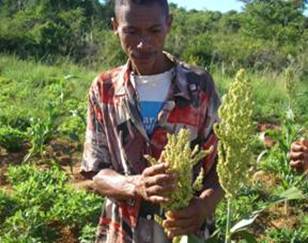
A team of ALT field trainers work to the agricultural calendar to identify farmers, set up farming groups and distribute seeds and provide technical trainings for those farmers who want to cultivate drought resistant sorghum. Radio programmes and sorghum festivals help to promote the drought resistant sorghum varieties that are proving successful enough to deliver food during the annual hunger gap.

The farmers engage to return a percentage of the seed they successfully grow to the project in order to improve stocks for further distribution across the region. Informally the farmers have also been reported to share additional seed with close relatives and neighbours, further increasing the take up of sorghum in the region.

Campaign 2008 / 2009


A total of 630 local farming families have benefited from seed and technical trainings in sorghum growing techniques.

Since the beginning of the project participating farmers have borrowed 800 kg, reimbursed 1,500 kg and harvested over 127,000 kg of sorghum seed.

This first harvest (May 09) has proved to be a very successful sorghum campaign. All the primary crops of maize were wiped out due to the late arrival of the rains in April 09. The sorghum beneficiaries were the only cultivators left with a harvest in May 09, with sorghum as the strongest and most resistant crop in the Androy.

Nutrition


A series of culinary trainings have been organised in July / August 09 with the 798 sorghum beneficiaries of the DMP and AS projects. These trainings served to promote the nutritional benefits of sorghum and demonstrate various cooking techniques.

In collaboration with local partners GRET and CITEA the DMP/AS teams have also designed a recipe booklet with colour illustrations highlighting the preparation methods, cooking techniques as well as several recipes. This booklet has been distributed during cooking trainings to local beneficiaries.


Campaign 2009 / 2010


Work to prepare the new campaign commenced in July 2009. The process of identifying new beneficiaries took place over August and September and 680 farmers over 34 new sites in 5 new communes have been identified. 34 new local trainers have been trained in Ambovombe to monitor beneficiaries during the next campaign.

Approximately 600 ha have been identified to dedicate to sorghum growing next season. ALT plans to distribute 1 000 kg of sorghum and 3 000 kg of peas given by FAO for this next season.

Rural Communications


Radio

Apemba Soa has produced over 128 educational radio programmes to create awareness, educate and help mobilise community participation. The radio programmes have increased knowledge and understanding about the project and ensured good participation for sorghum events/trainings. They also serve to address broader environmental issues.

The radio programmes are broadcast via the ALT PR rural radio network. This network ensures a considerable regional production and broadcast capacity for educational programmes reaching approximately 800,000 beneficiaries.

Festivals

Sorghum festivals have attracted thousands of participants and provide important events for sharing information, celebrating harvest and learning about nutrition

A total of 4 sorghum festivals have already been organised to publicise the sorghum reintroduction campaign, to demonstrate planting techniques and provide cooking demonstrations. Attendances at sorghum festivals have been high with crowds of approximately 2,000 people at each; the majority of all festivals were televised.

Lemur© The Andrew Lees Trust 1995 - 2010