|
DROUGHT MITIGATION PROGRAMME (DMP)INTRODUCTION After successfully securing new funding from the Big Lottery Fund, ALT launched its Drought Mitigation Programme (DMP) in December 2005 to address the need to improve food security and create livelihoods, whilst also promoting more sustainable natural resource management. The project reintroduced sorghum as a main crop with some success, educating and enabling farming families to grow and use seed varieties that are drought resistant that provide fodder and fuel, as well as food. Other important components of the project included tree planting at family level to help secure formal land tenure, and to provide fruit produce for families. And the launch of a commercial tree plantation to help stabilise poor soil areas, and provide employment and food produce. Download the Drought Mitigation Project Factsheet
HIV AIDS awareness activities ensured that members of this community enjoy full health to benefit from the results of the project. SORGHUM REINTRODUCTION
IMPROVED NUTRITIONFollowing the first agricultural season sorghum beneficiary families were producing 55% more cereal crops than the non-beneficiary sample group; 30% more after the second (poorer) agricultural season and an estimated 30-50% range for the final season. Beneficiary families have an average food consumption that is 53% higher than non-participating families. The results of the December 2008 survey showed that the average food consumption for a person in a beneficiary family was of 578.6 g per day, while a person in a non-beneficiary family was eating an average of 377.5 g per day. Participating sorghum beneficiary families have 10% higher average food consumption per household during month of December (middle of hunger gap) compared to non-participating families by the end of project.Looking ahead to the December 2009 hunger gap (after the project has ended) we can reasonably predict another big difference between sorghum growers and other farmers because the sorghum is showing great results due to its drought resistance capacity. This confirms that the DMP has achieved an impact that will continue increasing and spreading beyond the end of the project. 335 women received trainings and adopted improved recipes using sorghum. The project has provided training for women on the use of sorghum in culinary techniques. Members of the DMP team appeared on national television presenting different ways to prepare sorghum and have also participated in the festivals where cooking demonstrations were held. During the eight culinary trainings in 2009, the project distributed colourful booklets presenting nine sorghum recipes, with clear drawings adapted to the Antandroy culture and which promote the use of sorghum in daily diet. SORGHUM AS FUEL WITH FUEL EFFICIENT STOVES
Monitoring of TM-use during the project’s final year revealed that this figure has risen even further reflecting a final increase of over 100%. After the first two agricultural seasons 61 beneficiary families were already using sorghum stalks as a fuel. The trend is set to continue. LAND TENURE - TREE NURSERYOver 1,500 families bought (or received) and planted more than 22,500 value-adding trees. In total over 23,111 trees were sold or distributed to families, schools and associations. Planting trees increases land tenure security at local and regional levels, as planted trees are one of the principal (and traditional) indicators of land ownership. They also provide many environmental and social benefits, including soil stabilization, provision of shade and important natural resources (e.g. wood for construction), and food products that can be sustainably harvested and sold to generate income (e.g. mangos, papayas). The project has contributed to reform of land tenure legislation and processes at national level. Research conducted by the DMP at the beginning of the project was shared in meetings with the head of the National Land Tenure Programme and the Manager of Madagascar’s Millennium Challenge Account. Both these organisations are aiming to reform land tenure legislation and processes at national level. DMP’s detailed feedback on the land tenure situation in Androy has helped to ensure that national level reforms also address important regional issues around clan and family ties. Today, the DMP tree nursery’s income almost covers its yearly expenses and the management of the nursery is assured locally and independently, with ongoing technical support from the ALT team in Fort Dauphin and from other partners. ALT has implemented a strategy to ensure that the tree nursery will function in a sustainable way after the end of the project. The plan has been to reduce the number of permanent workers on the nursery site and to increase the price of the trees. During the first two years of the project the price of each tree was largely symbolic, but during the final year it was increased in a way that remains affordable for local farmers but also covers the majority of the cost. The sustainability of this tree-nursery is essential for the region, as it is the only one in the district of Tsihombe. All families who planted trees from the DMP nursery also received training on tree planting and caring for the young trees. The successful production scale up of more than 20,000 trees during the project’s final year together with the network built around the tree nursery are both very encouraging for the future.Strong contacts have been made with partner organisations (including other tree nurseries) in the south and these will help ensure that there is both a market for large numbers of trees as well as the necessary support once the DMP project ends. From 2009 The tree nursery will be managed directly under the auspices of ALT Madagascar. The new capacity of the nursery was demonstrated in March 09 when ALT was able to stabilise 25 dunes that were threatening arable land near the coast, using 5,000 seedlings of Filao from the nursery. See emergency relief. LIVELIHOODS - VK PLANTATION ALT assisted the local Antandroy association VoronoKodoho (VK) to launch a commercial tree plantation in Tshiombe.VK is registered as a formal village association. To date, their only significant income has been from member’s dues and the DMP, but in the future they will use the revenue generated from the sale of castor seeds (and later coconuts and potentially cashews as well) instead of grant funding. Statutes and commercial structure for cooperative, as well as framework documents for profit-share scheme established, have been established during the project. 4,000 castor plants harvested by the end of project (May 09). This will ensure sustainable income is generated that will be shared between association members. Trade chains for castor bean plants have already been identified and established. A local artisan in Ambovombe called Taza has already placed an order with VK to purchase their entire harvested crop. Taza will extract the oil under a contract that he has with SEAR, a Malagasy pharmaceutical company that specialises in producing soaps. Taza made a special agreement with VK to ensure that VK will sell the total harvest exclusively to him. In addition to this local operator a national company called Phileol is also promoting the cultivation of castor bean plants in the region. VK is waiting to know their price and partnership conditions so that they can ensure they are exploiting the best trade opportunities in the future. Approximately 1000 local people have directly benefitted from the project since its start.
In an area with so few alternatives and where 75% of the community lives on less than $1 a day, the importance of new economic activities cannot not be underestimated. The regeneration and activity brought about by the plantation is already feeding into the local economy and villagers are testifying about renewed hopes for development in the region. 120,000 square metres of poor soil in the commune of Antaritarike have been planted with castor bean plants, cashew and coconut trees. The plantation now covers more than 10 hectares of previous-degraded coastal land outside the town of Antaritarike. It is a very high profile development for such poor area. Furthermore, the adoption of castor beans offers new and interesting possibilities for the plantation, as these plants are currently providing the project with its first significant harvest since the DMP began. Established trade chains will ensure that all the harvest is converted into income for VK, which will be re-invested into the plantation according to their business plan. On the main site of the plantation: 12,276 castor bean seeds have been sown in 6,138 holes over 80,000 square meters.
72 coconut trees from the year-two agricultural season also remain on the site. On two new sites: 142 cashew trees are growing together with castor beans over a combined surface of 20,000 square metres. HIV AIDS AWARENESS AND RURAL COMMUNICATIONS
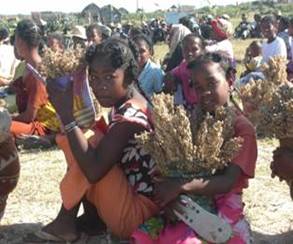
Radio programmes have employed using a participatory production cycle (PPC) including focus group research, script development, pre-testing and evaluation all of which create opportunities for participation and inputs from local stakeholders e.g. listening groups and technical partners. VISUAL AIDS The DMP field team has used a range of development tools and participatory approaches to make sure that all elements of the DMP activities were accessible to the most disadvantaged beneficiaries.This included the use of “pagivolts”, a series of illustrations on cloth that provide a visual learning aid for both the trainer and the trainee (particularly effective where beneficiaries have limited literacy skills). They have been used during trainings about fuel-efficient stoves. DMP’s communications activities have drawn heavily from oral testimony provided by beneficiaries and this has encouraged greater ownership of the activities. In partnership with PANOS London, DMP supported a project empowering community members to engage directly in regional, national and international debates on climate change, agriculture and development through the use of oral testimonies and participative video.Videos filmed by community participants from Faux Cap have been screened in Ambovombe for the region’s political leaders, as well as featuring at international conferences including the Indigenous Peoples Climate Change Summit in Alaska. The United Nations University has also asked permission to screen these videos at the National Museum of Denmark in Copenhagen in December, at an event scheduled within the important United Nations Climate Change Conference. See Project HEPA.Festivals are a perfect arena for disseminating information about sorghum: participants can observe the results of the good harvest, learn about techniques to grow sorghum and taste different sorghum recipes at the same time. 12 sorghum festivals promoted sorghum reintroduction, demonstrated planting techniques and provided cooking demonstrations. The festivals saw a combined attendance of over 4,000 people. The team’s approach and planning was similar for all the festivals, however those that drew the biggest crowds and had the best atmosphere were the festivals where DMP beneficiaries were most active in all elements of the festival preparations, including assuming significant responsibilities on the day. Attendances at the sorghum festivals has led to significant media coverage through radio and television programmes which in turn has contributed to widespread interest in growing sorghum again in the south of Madagascar. See also Apemba Soa |