ALT UK’S inquiry into the violation of an environmental buffer zone by Rio Tinto’s QMM mine in southern Madagascar

Traduction de cet BLOGpost en Francais disponible ICI

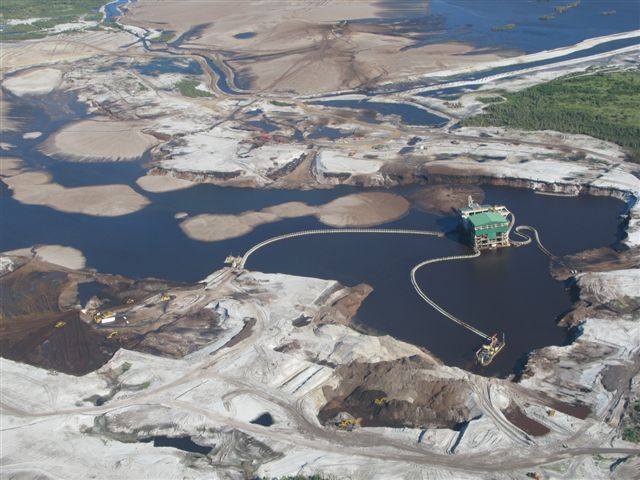
QMM mine in Mandena (2018)

Rio Tinto/QMM’s breach of an environmental buffer

Since 2016, the Andrew Lees Trust (ALT UK) has been researching the breach of the environmental buffer zone by Rio Tinto’s QMM mine operations at the Mandena site in the Anosy region, southern Madagascar.

The Trust has been concerned about the breach because local people have the right to a safe and healthy environment and, being highly dependent on direct access to natural resources for their food security and survival, the breach has potentially impacted water quality and the estuary system of lakes and rivers on which local people depend for fishing, drinking water and other important services. Citizens also have a right to information in relation to any release of pollutants to the environment due to QMM’s operational activities.

The Trust first raised the issue of the buffer breach and concomitant risks at the 2017 Rio Tinto AGM and has engaged with the company’s HQ in London over the last two years on questions arising.

The Trust commissioned two independent studies in relation to the breach of the buffer zone: one from the hydrogeology expert Dr Steven Emerman of Malach Consulting, to evaluate the extent of the QMM breach; the second from Dr Stella Swanson from Swanson Environmental Strategies, to review the radioactivity levels of the mine.

Reports and related articles can be found at www.andrewleestrust.org/andrew.htm. 

Key issues are also explained here: https://theecologist.org/2019/apr/09/rio-tinto-admits-buffer-breach.

For almost two years Rio Tinto /QMM denied the breach and claimed that the works in Mandena were “compliant”, despite the findings of their own contracted experts, Ozius, in 2018, who demonstrated the mine’s encroachment beyond approved permissions.  ALT UK continued to pursue answers and demand transparency. As a result, in a report issued by Rio Tinto in March 2019, and publicly at the 2019 AGM, the company finally admitted to the QMM breach of the buffer or sensitive zone by as much as 90 metres in places, and beyond legally approved permissions. Additionally, the company admitted to using QMM mine tailings to build its “berm”, which has extended onto the bed of Lake Besaroy.

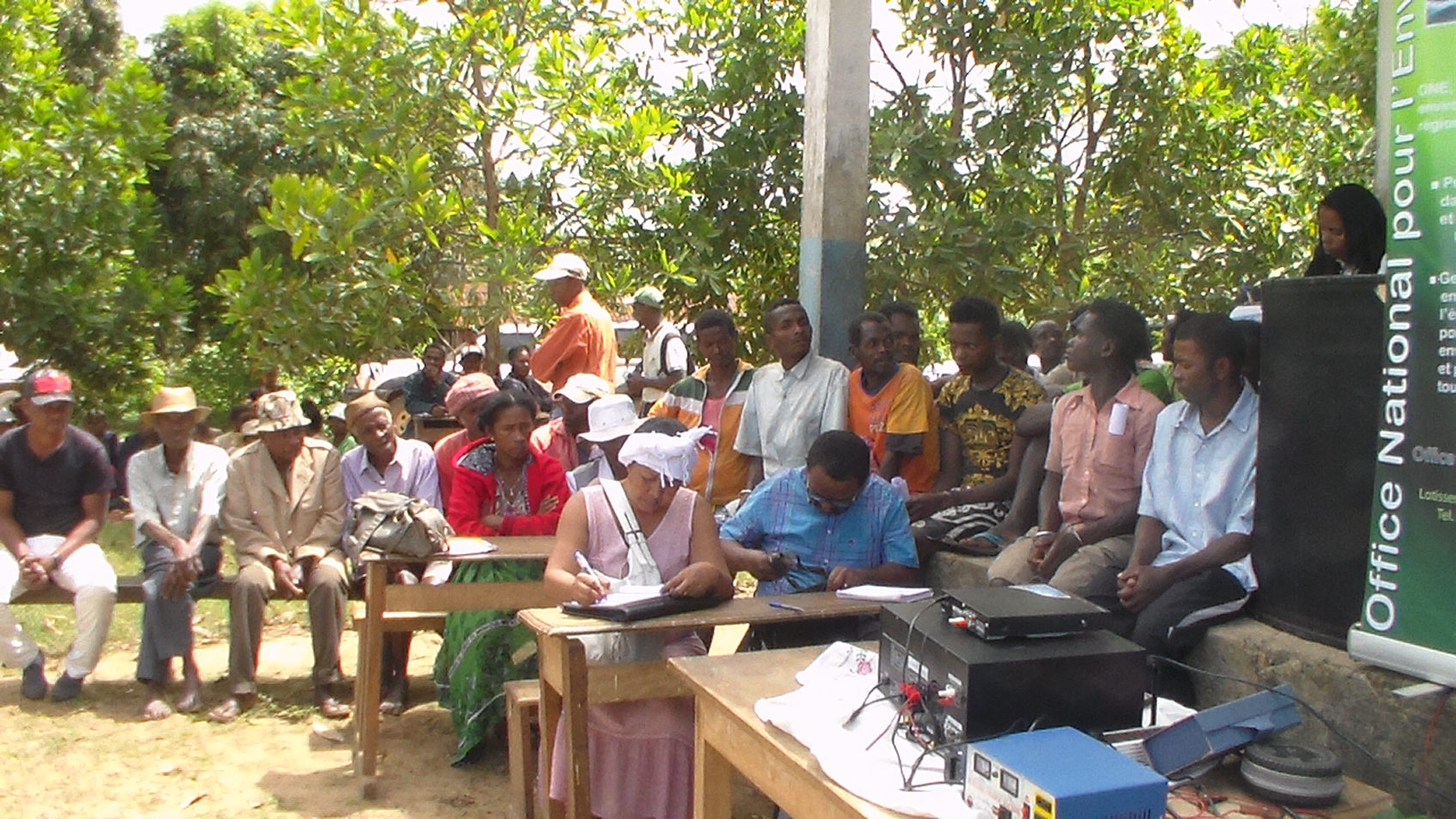
The QMM breach at Mandena is of concern for a number of reasons: it violates the public protection of waterways where people fish and gather drinking water; it exceeds the permissions granted to Rio Tinto/QMM by the Government of Madagascar to observe an already reduced buffer zone (from the statutory 80 metres to just 50 metres wide) as negotiated in 2014. The 50m limit was approved by the environment regulator, the Office Nationale pour L’Environnement (ONE) in 2015, after QMM had already breached the 50m limit that they proposed in their Social and Environmental Management Plan (SEMP); the breach violates national environmental law that protects sensitive zones, such as the waterways and lakes adjacent to the QMM mine, which are also protected under public domain legislature; it has exposed the lakes to mine tailings and increased the risk of toxic waste water from the mining basin entering the lakes; in this, it exposes local people who depend on the lakes and waterways for fishing, drinking water and other services, to health risks. See Google Earth Images of the mine breach here

The violation of the buffer zone by QMM received no sanction or penalties from the state regulator, ONE, as would be expected, and despite the obvious breach of national laws and agreements, and impacts on the local peoples’ environment.

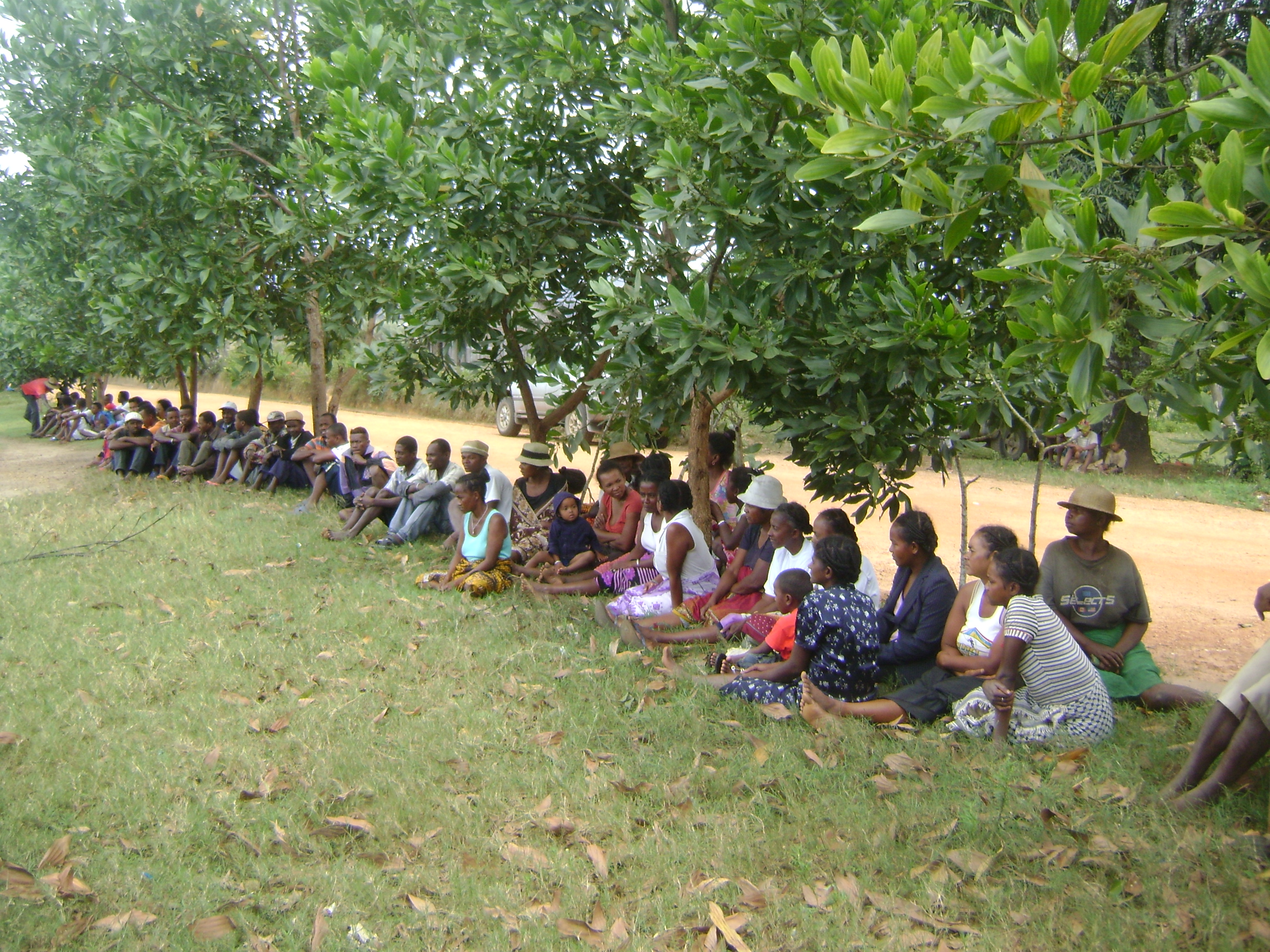
Fisherfolk on the waterways next to the QMM mine ( image courtesy of A Kraemer)

QMM Mine tailings and radioactivity

Rio Tinto has admitted that QMM’s mine tailings have been used to build the QMM “berm”. Moreover, the berm construction has encroached onto the bed of Lake Besaroy next to the mine site, bringing mine tailings into contact with the local estuary system.

Mine tailings and waste water from the mining basin contain enriched radionuclide content, because the ilmenite extraction process concentrates the radionuclides that are present in Monazite and Zircon, contained in the mineral sands.

The QMM ‘berm” is a structure intended to prevent tailings and waste-water from the mine basin from entering the adjacent lakes and waterways. As such, it would need to adhere to international dam construction standards, safety requirements and monitoring. However, in Rio Tinto’s recent listing of their mine storage facilities, the QMM mine is rated by Rio Tinto as having  “No embankment: excavated storage facility” (Rio Tinto, 2019). This description ignores the existence of the “berm”, or its function as a dam, and thereby potentially circumvents the prerequisite safety criteria.

The concern that toxic waste has entered the local water system has been deepened by ALT UK’s independent radioactivity review that identified elevated uranium levels in the water around the mine’s waste water discharge points, 50x times higher than World Health Organisation (WHO) safe drinking guidelines in some places.

The company has claimed that the elevated uranium levels identified in the water around the mine are all naturally occurring due to high background radiation levels. In reality RT/QMM cannot make this claim since they failed to carry out the necessary monitoring, or deliver relevant scientific data to support their argument. Indeed, ALT UK’s radioactivity expert, Stella Swanson, who has some 40 years standing in the industry and who consulted closely with Rio Tinto’s own expert, found QMM’s monitoring of ingestion pathways for radioactivity around the mine (water, soil, food) to be “unacceptable”.

Questions and demands

In April 2019 ALT UK brought its concerns to the Rio Tinto AGM, and is still in discussion with Rio Tinto HQ about what has happened and what needs to be done.  This includes asking that the company follow WHO guidelines to provide alternative safe drinking water sources for communities living around the mine site; a full translation into French of the main 68 page Swanson radioactivity review for local stakeholders, QMM staff and government and national agencies involved in monitoring the QMM mine; also a full, independently led and appropriately designed local communications programme to understand and address local concerns about the mine’s radioactivity levels – such as can educate and inform local communities about radioactivity, address their questions and concerns, and help them manage their lives around the QMM mine to assure their health and safety e.g. reduce incremental exposure.

woman with Eel Andrakaraka (image courtesy of A Kraemer)

In 2017, before commencing its studies, the Trust insisted that the findings of its independent radioactivity review be shared with local communities in appropriate and accessible ways. The Trust has this year offered a six-page communications advisory paper to Rio Tinto, which advocates an independently led communications programme and identifies experts who can assist QMM with this challenge. As yet the company has not responded to this communication paper.

Rio Tinto’s CEO did respond to two questions/demands at the Rio Tinto 2019 AGM: to agree the translation and address the communications issue. However, the company declined to take up the Trust’s and Swanson’s recommendation to address a high priority item: the provision of alternative safe drinking water sources for locally affected communities.

A recording of the entire Rio Tinto 2019 AGM is available here ; ALT UK questions appear at times : 49.25 and again at :  1.45.26

The Trust believes the safe drinking water issue should be placed within the context of understanding that 1) it is a WHO guideline given the health risks to local people, 2) QMM has failed to distinguish between pre-existing natural background levels in the water and the impacts of their mining operation, and 3) the violation of the buffer zone by QMM received no sanction or penalties from the state regulator, ONE, as would be expected, and despite the obvious breach of national laws and agreements, and impacts on the local peoples’ environment.

Local governance and transparency

Additionally, ALT UK is finding it extremely hard to access the 2018 ONE report that reported the QMM buffer zone work as “compliant”; and then, subsequently, a further ONE document that apparently evaluates the breach impact as “negligible”. ALT UK has repeatedly asked Rio Tinto to provide the relevant ONE reports but without success; the ONE also failed to respond to a request for relevant report/s.

This failure to share reports, especially when Rio Tinto/QMM is paying ONE for the evaluations of the QMM mine, reinforces local concerns about the relationship between QMM and ONE. At local level there have already been complaints that the relationship between QMM and ONE is “compromised”- including a public complaint made by a local deputy to the Minister of Environment during a visit to Ft. Dauphin in 2018.

More about the governance issues in the joint briefing and the letter sent to government ministers from Publish What You Pay here

Following a letter of enquiry sent in 2019 by ALT UK in collaboration with Publish What You Pay, Rio Tinto has shared details of payments made to ONE during the relevant SEMP approval and evaluation reporting time frames. On average the company appears to be providing support to ONE in the region of USD$30-40,000 per year, with a tendency toward on-going financial contributions, such as may risk dependency and create conflicts of interest; especially if works undertaken by ONE are not then readily available for scrutiny.

The amounts also suggest that no external, independent expertise was engaged by ONE to assess the buffer zone breach in 2018, or the impacts of constructing a berm using mine tailings that extended into the lake – e.g. on water quality; this suggests that the validation of the QMM works as “compliant” has not been concluded following a thorough technical examination such as would be necessary. For example, Rio Tinto paid almost USD$60,000 to Ozius just to study the buffer zone encroachment. No such increase in funds appear to have been made available to ONE in order to engage its own experts for the evaluation process; nor has it been suggested that ONE have referenced the Ozius report, which in any case clearly demonstrates the breach of the buffer and encroachment onto the lake. Indeed it remains unclear how ONE reached its conclusions on the status of the breach or the impacts of the encroachment as “negligible”.

Read

Rio Tinto/QMM openly states that the company is making payments to ONE, as allowed under the MECIE decree; however, the company’s failure to make the ONE reports available when asked represents a serious lack of transparency and risks undermining robust, objective and credible governance at local level.  Most especially so when Rio Tinto/QMM are citing the ONE regulator and its reports publicly to claim “compliance” with their government approved Social Environmental Management Plan (SEMP) or convince shareholders of the “negligible” impact of QMM’s buffer breach on the local environment.

Weaving Mats in the villages around Mandena (image courtesy of A Kraemer)

Community engagement and accountability

Throughout the process, ALT UK has learnt that many community members knew little or nothing about changes to the QMM mine plan e.g. a reduced, 50 metre buffer (SEMP 2014-2018); or of further changes to the operational plan made in January 2019, such as normally require open community consultation. ALT UK is concerned that full consultation processes may not be happening, or may be confined and simplified to direct engagement with Mayors and Chef du Fokontany for rapid decisions and approvals.

Following complaints made to Rio Tinto HQ in 2017, the Trust was informed that internal training and procedural processes at QMM have been reviewed in order to improve QMM’s local social engagement mechanisms with communities; a new “Norme des Procedures” has been developed and apparently came out of that work. ALT UK has been promised sight of this document – but so far has not received a copy.

Poor or limited consultation processes with communities and lack of transparency over availability of data and information has been a concern of the Trust over many years.  Throughout this inquiry, ALT UK has had to be extraordinarily persistent throughout the dialogue with Rio Tinto in order to advance its enquiries and it took significant pressure from ALT UK for the company to finally admit the buffer zone violation. Rio Tinto has still not addressed many of ALT UK’s technical questions and documentation requests. Importantly, ALTUK has had to work full-time on these issues for over two years.

Research and advocacy work of this kind is demanding, time consuming and requires considerable technical assistance from independent scientists. No such resources are readily available to local communities in Anosy. In this, the two-year process highlights the difficulties for local citizens to hold the company to account, especially when they are faced with the daily challenges of surviving on less than $2 per day.

Indeed villagers appear to have had no capacity to prevent the loss of the inland Lake Ambavarano to the new perimeters of QMM’s 2019 butterfly mining (next phase of dredging), which QMM claims local people “rarely use” but which locals do employ for at least four months of the year in the “Asiotry” period, as well as accessing forest products around the lake all year; nor to stop QMM’s destruction of forest in the buffer area of the conservation zone in Mandena to create a new access route; both of which demonstrate a disregard for local people’s access to vital natural resources, and the power asymmetry that favours the company’s interests.

ALT UK’s research around QMM buffer breach/radioactivity levels has not involved any locally based NGOs /CSOs.  The work has been highly technical in nature with the focus on establishing scientific facts. Additionally, ALT UK was required to work under a confidentiality agreement from Rio Tinto in order to access QMM’s radioactivity monitoring data and associated reports, which has further impeded partnerships or local collaboration in the process. ALT UK has ensured some direct contact with community members in Anosy, thanks to the ALT UK Director’s long-standing personal relations in the region. This has helped maintain checks on local realities and concerns, but has only been possible intermittently, and on an ad hoc basis.

In this regard there is still a great deal of work to do in order to understand what is happening around the QMM mine in Mandena, how consultation and communications with communities is happening with QMM, whether citizens’ rights to a safe and healthy environment and their rights to information are being fully respected, how good governance can be achieved around the mining operation, and in what way any environmental or social abuses will be appropriately and justly addressed and remedied.

Vegetable gardens

Impacts, discussion and dissemination

The ALT UK research and advocacy work on the QMM breach has already had a number of impacts, with the company making a series of admissions and commitments. However, follow up on the outcomes of these commitments is required, as well as improved independent monitoring and evaluation of the QMM mine.

The Trust has engaged with a number of international agencies throughout this research and advocacy work, and collaborated closely with some NGOs, including Publish What You Pay, the London Mining Network and Friends of the Earth. It has also communicated with groups, researchers and individuals who have concerns or interests in the Rio Tinto QMM operations, including members of QMM’s International Independent Advisory Panel (IIAP) and Biodiversity and Natural Resource Management Committee (BNRMC), to alert them of the buffer breach and concomitant risks.

The issues and the studies /findings have been shared widely through online networks such as POLLEN and the Madagascar Environmental Justice Network, and via direct correspondence from ALT UK, including with activists, researchers, members of the Malagasy diaspora, academics, shareholders/investors, conservation organisations such as the IUCN and WWF Madagascar, other relevant bodies such as Extractives Industry Transparency Initiative, Transparency International, and with the World Bank – under whose project funding timeline the QMM violation occurred (World Bank PIC programme).

Ethical investors are particularly focused on the extractives industry’s management of mine tailings following the Brumadinho tragedy earlier this year. The Church of England Pensions Fund, for example, has launched an initiative to promote improved safety and regulation of mine tailings storage facilities. The breach of the buffer zone in Madagascar raises specific questions about QMM’s management of its mine tailings, and associated risks; these have been explained in detail in Emerman’s second report, and been the subject of extensive enquiry by ALT UK to the company.

The QMM buffer zone breach raises questions about Rio Tinto/QMM’s respect for local people’s human rights to a safe and healthy environment and their rights to information. It also raises questions about the manner in which public private partnership projects of this kind are monitored, evaluated and held to account when they fail to respect the environmental standards expected of them – including in terms of their own corporate commitments, the national regulatory frameworks and laws, and by the international funders and organisations who have partnered with them.

Reports and Contact

For further information please contact: yorengo@andrewleestrust.org

Posted in Advocacy, Madagascar | 1 Comment

Happy Women’s Day 2019

The women of Andry Lalana Tohana (ALT Mg) at the International Women’s Day celebrations in Ft Dauphin on 8th March 2019

see Andry Lalana Tohana

Posted in Madagascar, The Trust | Leave a comment

New tricks: biodiversity offsetting and mining

https://policy.friendsoftheearth.uk/publications/new-tricks-biodiversity-offsetting-and-mining

Our new report with Friends of the Earth :

Governments and businesses are presenting biodiversity offsetting as a nature conservation solution. However, in a new report Friends of the Earth and the Andrew Lees Trust UK  show that it’s just a green makeover for more damage by mining and development schemes, especially in some of the world’s most fragile nature hotspots.

Summary

From Madagascar to middle England this report by Friends of the Earth and the Andrew Lees TrustUK exposes how harmful mining, development projects and infrastructure schemes are deploying ‘biodiversity offsetting’ as a new form of conservation action in an effort to maintain business as usual activities.

Developers, industries and their lobbyists are using offsetting to mask the damaging effects of their largely unreformed activities and to further persuade governments, academic bodies, parts of the conservation sector and communities on the ground that their activities can be trusted to be clean, green, fair and sustainable.

Behind the promises and the allure of biodiversity offsetting as an apparent solution to nature’s decline, New frontiers, new tricks finds that the makeover of offsetting is just the latest sustainability gloss for unreformed, fundamentally unsustainable industrial activity and poorly conceived development.

Biodiversity offsetting is no substitute for lasting changes in business and industrial practices and for proper investment in proven nature conservation action to reverse the decline of nature and natural ecosystems……

Posted in Advocacy | Leave a comment

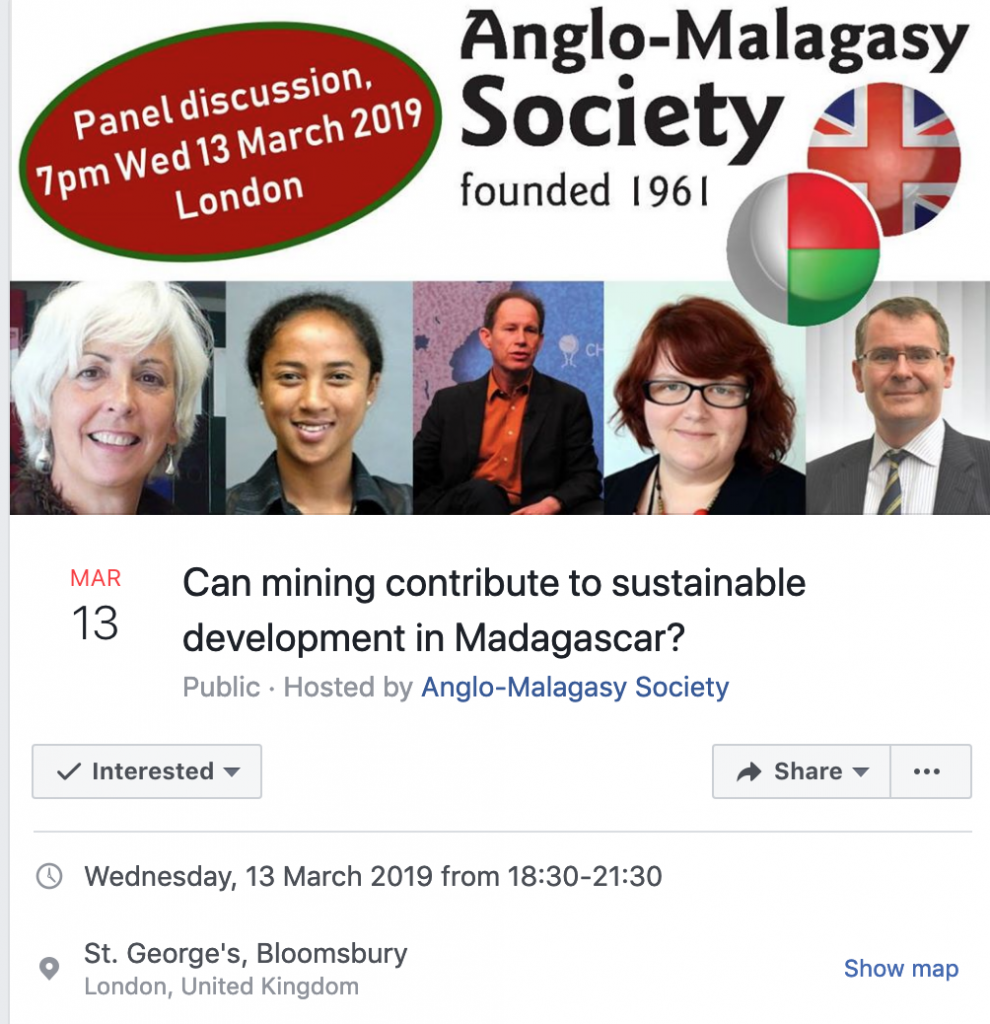
Anglo Malagasy Society – panel discussion on mining in Madagascar

The Andrew Lees Trust’s Director, Yvonne Orengo, will join a panel discussion at the Anglo Malagasy Society (AMS) in London to debate mining in Madagascar- see the AMS information below and link to access tickets:

Buy tickets here

Panel discussion: Can mining contribute to sustainable development in Madagascar? 19:00, Wed 13 March 2019

This panel discussion will explore case studies of mining in Madagascar, including Rio Tinto, Ambatovy and Tulear Sands, and discuss some of the pressing social and environmental challenges that extractives projects present to the island and its citizens. The discussion will also include enquiry around the regulatory, legal and economic frameworks and how these support or undermine the value of the extractive industries’ contribution to the public purse and the realisation of Sustainable Development Goals (SDGs).

Four panellists with a long history of working in a wide range of contrasting sectors in Madagascar will present and debate key questions; there will also be a Q&A session with AMS members, and participation is encouraged to ensure a range of views are heard.

Moderator: Paul Melly (Chatham House) Panelists: Amber Huff (political ecologist, Institute of Development Studies); Vola Parker (author of ‘Rio Tinto and Madagascar: is it Equitable?’); John Ffooks (John W Ffooks & Co, lawyers specialising in natural resources); and Yvonne Orengo (Director, Andrew Lees Trust).

The ticket price for the evening event includes a free bar and delicious Malagasy buffet dinner. There will be a chance to chat with the panel and mingle with others to chat about Madagascar before and after the lecture.

Time: Doors open at 18:30 for a 19:00 start.

Venue: Access to the Upper Vestry Hall is at the back of St George’s Bloomsbury in Little Russell Street. It is near Tottenham Court Road and Holborn underground stations.

Tickets: Tickets for the event, including buffet meal cost £15 for society members, £20 for non-members and £9 for students. You can book and pay online here. Please book in advance (we need to know numbers for catering); tickets bought ‘on the door’ are subject to a £5 surcharge.

Posted in Advocacy | Leave a comment

Strengthening communications capabilities in the south: Participatory Video (PV)

Women at the Participatory Video (PV) training workshop with InsightShare in Tulear (Mme Hanitra of ALT MG third from right, back row)

In its work to strengthen civil society and to support the sustainability strategy of Andry Lalana Tohana in Madagascar (ALT MG) the Andrew Lees Trust (ALT UK) secured funds from the Aldama Foundation to provide dedicated training in Participatory Video (PV) production for ALT MG, and upgrade their media equipment.

ALT MG brings considerable capability and experience in Communications for Development (C4D) and the use of media in the development context in southern Madagascar. This includes the team’s ten-year experience of the work of the ALT UK (e.g. Project Radio/Project HEPA Oral testimony) as well as subsequent collaborations such as the Village Voices for Development programme.

However, over the last few years, ALT MG recognized and voiced their need to update PV media skills, revise methodologies and develop new techniques.

Participatory Video (PV) Training:

PV training in Tulear

Over a number of years, discussions had been underway and collaboration sought with InsightShare (Oxford), a leading agency in training Participatory Video (PV) in Africa and developing country contexts. In January 2018 ALT UK was informed that InsightShare had been selected by Transparency International (TI) to bring PV training to Madagascar. ALT UK was able to introduce ALT MG’s Director, Mme Hanitra, as a participant to the InsightShare Madagascar training and also promoted a role for her in the training as a co-facilitator of the workshop.

Participatory Video (PV) Training

The first training workshop took place in Tulear over 10 days between 5 au 16 mars 2018 and included practical techniques of video production. 11 women from the Lutheran church mission in Tulear were trained. The women also then prepared their activities leading up to the next training, in June 2018.

Training in Tulear, the PV team use iPad for recording

The second training was focused on editing and finalising the vision of the films the women had produced; also airing them at a meeting with local authorities and the public in Tulear. A meeting in Tana with TI took place in June to report on the two workshops/trainings and discuss future collaboration.

Mme Hanitra established a strong role in the workshop process thanks to her extensive experience of working across the south on communications issues and C4D projects. She was able to help orient the trainer and the training workshop within the southern context; and especially with regard to the target theme of women rights to land inheritance as this was subject previously treated by ALT MG in a number of radio programmes for the Village Voices for Development project.

participants learn interview and filming techniques

  1. Women Produce Films about Women’s Land Inheritance challenges

11 women were trained in PV and developed skills in communications using video. They produced five films about the challenges of land inheritance for women in Southern Madagascar.

The films can be viewed online at:

https://www.youtube.com/watch?v=Go4sSzNZqQc&t=5s

https://www.youtube.com/watch?v=wPVQarBoL1E&t=1618s

https://www.youtube.com/watch?v=wPVQarBoL1E&list=PLUtvIa4Yp5ykk1f5OehA5v_msJIzq5GBL

https://www.youtube.com/watch?v=e_Wq-yYGxbg&t=31s

https://www.youtube.com/watch?v=S4e2A_cqVQk&t=1s

The films were shown in Tulear at a public meeting and additional opportunities are being sought and discussed to air the films at other public showings in different regions, e.g. by ALT MG in Anosy.

Hanitra (sitting) with Landy (of Transparency International) presenting the video material to the community in Ankoronga

This initiative by Transparency International with training from InsightShare provides opportunities for self-expression and empowerment usually denied women in southern Madagascar, where men dominate decision-making and women are frequently prevented or barred from speaking out in public.

The films have helped the women to expose the ways that traditional practices and inherent prejudices against women leave mothers and children homeless and destitute following the death or divorce from a husband because their constitutional rights to inherit land are ignored.

The PV process helps develop new confidence and public speaking skills for women, as well as advocacy opportunities to help change attitudes and practices.

ALT MG has strengthened its skills set in PV and its position as C4D experts in Madagascar. Mme Hanitra established strong links with Transparency International Mg, and with InsightShare, and has positioned ALT MG to be a partner for future work across Madagascar using Participatory Video (PV).

Video Equipment

The InsightShare training employed state of the art Apple iPad and accompanying video edit software. The feedback on using this technology was extremely positive, not least because the edit could be done on the same instrument as the filming thereby reducing time and difficulties in downloading and transferring images. The use of the iPad precipitated a request from ALT MG to have this equipment for future PV project work in the south. With help from InsightShare, an iPad  kit was put together and sent to ALT MG at the time of the second training in Tulear.

Feedback from ALT Mg:

“ ALT MG is an active member of the C4D network in the South. The pillar of C4D is an evidence-based approach, necessary if you really want to change behavior. Participatory video collects and shows the situation, challenges and achievements using the community’s own words and images. The videos produced will be used to stimulate awareness and exchange and most importantly help advocate community rights to the relevant authorities.”  Hanitra Raharimanana, Director of ALT Mg.

Chris Lunch and Hanitra in Tulear

Feedback from InsightShare

“ Having Hanitra on our training was invaluable; it was amazing to have someone local who is so experienced at working at community level. Her presence provided a gateway for Insightshare to make our dialogue and how we introduced topics – like “what is social transformation?” – that much more effective. Hanitra was very good at articulating some of these important ideas using language and metaphors that totally connected with the people. This helped us to go deeper than we might otherwise have been able to do, and to ask some of the questions that are really important for social change…we were working on a sensitive subject with lots of taboos – and being able to discuss these with Hanitra was really useful. So was her help in resolving issues or challenges in the group – as always occurs when people have never worked together before; Hanitra was on the same wavelength as us, which was very affirming.  We hope that this PV work can take root in Madagascar, and that we can work with Hanitra again in the future.” Chris Lunch, Director, InsightShare.

11 Women receive certification for their training in Participatory Video in Tulear


Posted in Andry Lalana Toahana ALT Madagascar, Communications, Education and Life Skills, Madagascar, Uncategorized | Leave a comment

STRENGTHENING LOCAL CIVIL SOCIETY

Building Capacity for Management and Monitoring

The Andrew Lees Trust (ALT UK) has supported the development of local Malagasy NGO Andry Lalana Toahana (ALT MG) since its inception in 2009. This has been part of the Trust’s long-term commitment following its Responsible Exit from Madagascar.

Research has shown that leadership and management skills are critical for developing and sustaining local civil society organisations. Developing core competencies is therefore a necessary strategy for the long-term health of the local organisation and for supporting local people’s development agendas.

Training field recorders to collect data for the cash transfer programme

As ALT MG’s programme of activities and community reach has grown, so too has the demand to manage and monitor the work across multiple work teams and geographic distances.

These demands inevitably place pressure on the Malagasy NGO to increase its capacity. However, international and national donors do not always provide sufficient budget to assist local NGOS in this aspect of their work .

ALT UK therefore aims to be responsive to the requests for help in this aspect of ALT MG’s development.

Growing New Skills to support Famine Relief

One example is ALT MG’s work on the famine relief in the deep south. As the activity advanced, so too did the volume of monitoring and reporting.

In particular, collecting and recording data on cash transfer payments and family support activities. The exacting science and reporting around data management and evaluations is time consuming and requires specialist skills.

ALT MG therefore sought financial assistance from ALT UK in order to be able to recruit a specialist in monitoring and evaluation.

Mme Olga meets with artisans in Ankarefo

Funds were sent to support the recruitment and salary (for the first year) of a local Malagasy expert who could assist the Director with monitoring and reporting demands, and with the development of new funding requests, vital for the long-term health of the organisation.

ALT MG identified and contracted Mme Olga Marovavy SOLONDRENIBE, a technical expert in computer management and monitoring and evaluation, with excellent experience across a range of development projects in the south of Madagascar.

Mme Olga joined the ALT MG team in February 2018 to provide this specific skill set, as well as providing additional management and fundraising support for ALT MG.

The financial help that is coming from the UK is very important for strengthening the capacity of ALT Mg.  The projects we are running currently do not afford the possibility for us to develop, as we must, because the donor budgets are so restricted; there are no budget lines to support admin or an assistant’s salary, for example. …There are still so many development activities to do in Madagascar and the team benefits from Olga’s expertise to apply for these opportunities in order to stabilise the future of the organisation and also to ensure the competence necessary to assist the local population”. Hanitra Raharimana, Director ALT Mg

Mme Olga designed a new data base to track cash transfer payments and other FSS activities

Mme Olga’s arrival brought many positive changes. The entire database on the FID/FSS famine relief programme was re-designed and brought fully up to date with all cash transfer payments and related activity. It was reorganised to be more manageable.

Mme Olga also assisted the field team to improve their skills and capacity to manage data collection for field reporting requirements. 

Mme Olga also developed a new funding proposal for Tany Meva (a Malagasy Environmental funding body).  She successfully secured the Tany Meva funding to develop a brick making enterprise for local people, which provides livelihoods as well as reducing deforestation and related environmental impacts (houses are usually built from wood in the south).

Mme Olga meeting with artisanal brick-makers at Nosibe

It was with huge sadness we heard of Mme Olga’s sudden death in late 2018, following a misdiagnosed illness. The ALT MG team were devastated by the loss of this warm and talented professional. ALT MG has dedicated its local artisan brick-making project to her memory.

Posted in Supporting Civil Society, Uncategorized | Leave a comment

Antsotso Accompaniment

Antanosy villagers with a traditional pirogue (dug out canoe)

In the south of Madagascar more than 82% of the population are poor, subsistence farmers reliant on access to land, forest and natural resources to survive. In the local context, communities are frequently isolated, disenfranchised and suffer multiple challenges to voice their needs, protect their resources and realise their aspirations.

This is especially the case when state-corporate-INGO alliances determine policy and advance agendas without consulting  local people in decisions that affect their lives.

One community facing this challenge is Antsotso in the Anosy region…

Antsotso – A community on the edge

Antsotso community gather for a meeting

Antsotso community has lost significant food production capacity due to externally driven conservation of its forest and land. Conservation to protect the forest at Begamindidy-Ivohibe, some 50km north of the mine site where Antsotso is situated, is part of the Rio Tinto QMM mine’s Biodiversity Offsetting programme. The ‘offset’ essentially seeks to compensate the loss of 6000 hectares of indigenous coastal forest, which is being dredged by QMM for ilmenite, by protecting and conserving other forest areas which it considers to be of similar or ‘equal value’ elsewhere.

The conservation programme is enshrined under national, state laws and implemented in this case by a local affiliate of Birdlife International, Asity, in partnership with the Rio Tinto QMM[1] mining operation in Anosy.

Rio Tinto’s QMM mine dredging coastal forests of Anosy

The offset means that land and forest that has been used by the Antsotso community for generations to grow their food, and to cut trees to build their pirogues (wooden dugout fishing boats), is no longer available to them. In losing the land and forest the community have also lost their food security and livelihoods. Where before they grew manioc close to the forest, they are now forced to grow food in sandy soil by the coast. The community reports that where before they could produce enough food in one season to last them two years, now it will only last two months. If they cut trees to make dugout canoes for their fishing, they risk fines and having the boats destroyed.

When the offset programme was set up, there was no Free Prior Informed Consent with Antsotso as required under Articles 26 of the UN Declaration of Rights of Indigenous Peoples, and ILO 169. The community was given promises by Asity for tree planting projects and income generating activities that have failed to materialise in any viable form, and the resilience of villagers to survive on their traditional, ancestral lands has consequently been undermined.

Community Challenges

Activists raise awareness at the Rio Tinto AGM in 2017

The community’s challenges have been brought to light through various international actions  since 2015 including published research and reports, film, press articles, events and shareholder actions to raise questions to Rio Tinto at their AGM.

On the ground in Madagascar the community face tough challenges to be heard and have their rights respected and protected.

Rural populations in southern Madagascar are seriously disadvantaged through lack of knowledge about their human rights under the UN Charter, to which Madagascar is a signatory; especially rights to information and freedom of speech. Isolation, grinding poverty, and low educational and literacy levels can hamper citizens’ ability to engage with decision makers. [See also Voices of Change and Village Voices.]

Most particularly, citizens are hindered by the power asymmetry that favours the state-corporate relationship above the needs of local people. Where the mining company has significant resources, and a plethora of technical advisers and lawyers to help them advance their interests, the community has little resource and no one to help them in the complex interface that ensues.

Last year, local people communicated to ALT UK that interactions with external actors visiting Antsotso were difficult and disabling for the community. For example, the mining company, QMM, was providing just a few days notice ahead of their arrival for important meetings at village level. This afforded the community no time to meet, discuss, develop consensus and prepare decisions amongst themselves, thereby undermining a cohesive approach to engagement and negotiations.

In discussion about these challenges, and in response to local requests for assistance, ALT UK undertook to support an accompaniment programme for Antsotso.

Accompaniment for the Community of Antsotso

Supporting local actors for change and strengthening the ability of local CSO’s to respond to their constituents needs and agendas is in line with ALT UK’s current ‘GroundSwell’ strategy[2]. Additionally, ALT UK brings practical working experience and understanding of natural resource management, food security and communications in the south of Madagascar.

In order to respond to the community’s need for assistance, ALT UK entered into discussions with Trano Aro Zo (TAZ). TAZ is a locally based Malagasy association mandated under the UN to provide human rights training in the south and provide citizens advice services to citizens, including in the Anosy region.

Memorandum of Understanding ALT UK/TAZ

TAZ trainings on human rights and their ‘citizens advice’ services are free except where they have to travel outside of Tolagnaro (Ft Dauphin, Capital of Anosy).

Direct funding support via ALT UK has enabled TAZ to visit and deliver training and advice face to face in the community e.g. to cover petrol /travel costs, for the 13-15 hour round trip – to Antsotso; also any fees and training materials. It also covered the cost of other training or translation services as required.

In order to ensure local ownership of the process, ALT UK established an MOU with human rights association Trano Aro ZO (TAZ). Under the MOU, TAZ provided assistance to the community according to their requests, including training in human rights, advice on rights and laws, and accompaniment at important meetings to observe, and record proceedings as a legal witness. This has afforded a level of transparency and protection, as well as education for the community.

TAZ services explained to Antsotso

The MOU established the Antsotso community as TAZ’s client, with accompanying recognition of client confidentiality. It also ensured an advance of funds to be used for visits as necessary by TAZ. In this process, the community has determined their needs and decided the involvement of TAZ by issuing invites to meetings and requests for assistance.

Arrangements were also made to include collaboration with a local, independent consultant to provide communications training and translation services as necessary.

Keeping engagement equitable and transparent

With the agreement of the community and the knowledge of the UN and Office of High Commission for Human Rights in Madagascar, TAZ first attended the community at a meeting in July 2017:

Meeting with Rio Tinto’s Ethics and Integrity Investigator

Rio Tinto sent an officer from London to investigate questions of cash payments made to Antsotso community representatives ahead of their attendance at a meeting in QMM offices in May 2017. TAZ provided legal witness  alongside a local translator/consultant known and trusted by the community.  Rio Tinto summarised its findings in November 2017. This summary incorporated recommendations from ALT UK, which had been reviewed and validated by the community, including that the community be entitled to have legal witness, advisers, translators etc, present for their meetings with QMM, without prejudice. See ALT’s report on the Investigation process here

In August TAZ went back to Antsotso with the local consultant to gather feedback from the process and explain to the community the full range of their services for Malagasy citizens. The Antsotso community decided they wanted  TAZ’s assistance going forward.

Strengthening capacity in communications: Meetings with outsiders

communications sessions: exploring community ideas and concerns

The community already has considerable experience in facilitating meetings through traditional and customary practices; but the practice of QMM and others agencies to call meetings with almost no warning and very little forward information does not lend itself to traditional forms of community decision-making processes.

An orientation session in August therefore sought to discuss how best to reinforce and strengthen existing capabilities, while also offering insights and tools for managing interface with external agencies, in particular with foreign visitors e.g. from the mining company, international NGOs etc.

 The session was designed using a Communications for Development (C4D) approach to strengthen skills and increase confidence, for example, to demand an agenda, ample warning and information about who was coming to see the community and why. The session included understanding rights e.g. to information, and to cancel or rearrange meetings to ensure time for internal preparation and consensus building.

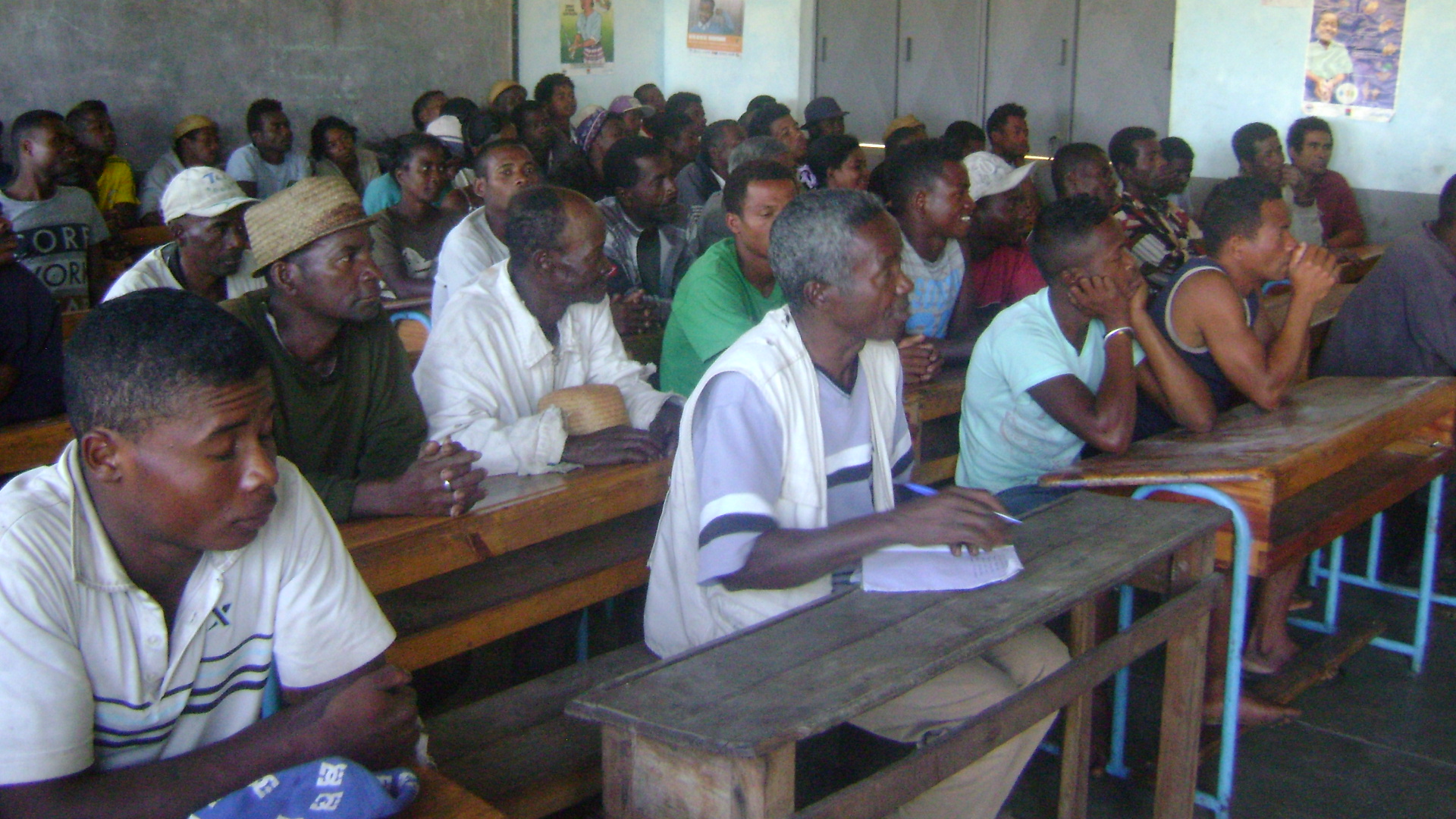
28 people, 24 men and 4 women, participated in the training. The training was designed for the participants to share their learning with their respective village groups and families.

The local communications consultant led the session, with assistance from TAZ. The content was developed in collaboration with ALT UK’s Director, a C4D practitioner, with inputs from local experts. The session also included a participatory workshop to help villagers identify their challenges and solutions.

The community reported to the local consultant that they

“greatly appreciated the training and they could apply what they had learnt; even if we only talk about the fact that they can refuse, roll back or organize a meeting. They thanked us for that. Because before, they did not know these rights…. Otherwise, they will be happy to learn more about the rights that TAZ can teach them through training sessions”.

Understanding the UN Charter of Human Rights 

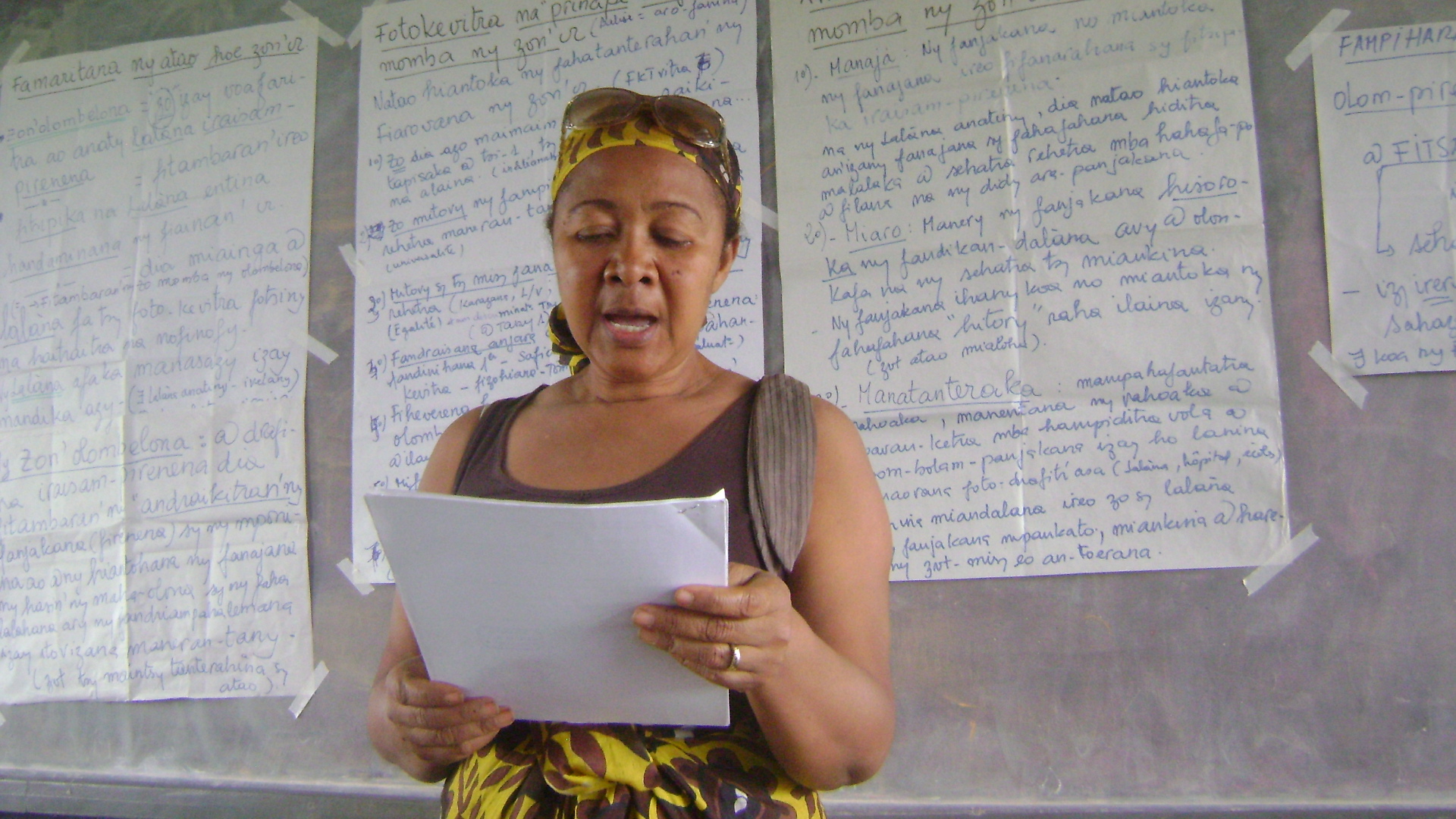
TAZ Director Mme Sahondra explains the UN Charter of Human Rights

To respond to the community’s request and complement the orientation on communications, training was delivered to help the community understand their rights. TAZ designed and delivered the training in September 2017. All aspects of the UN Human Rights Charter were explained. Also the responsibilities of foreign companies to respect human rights, rights to recourse where appropriate, and laws regarding the forest. 

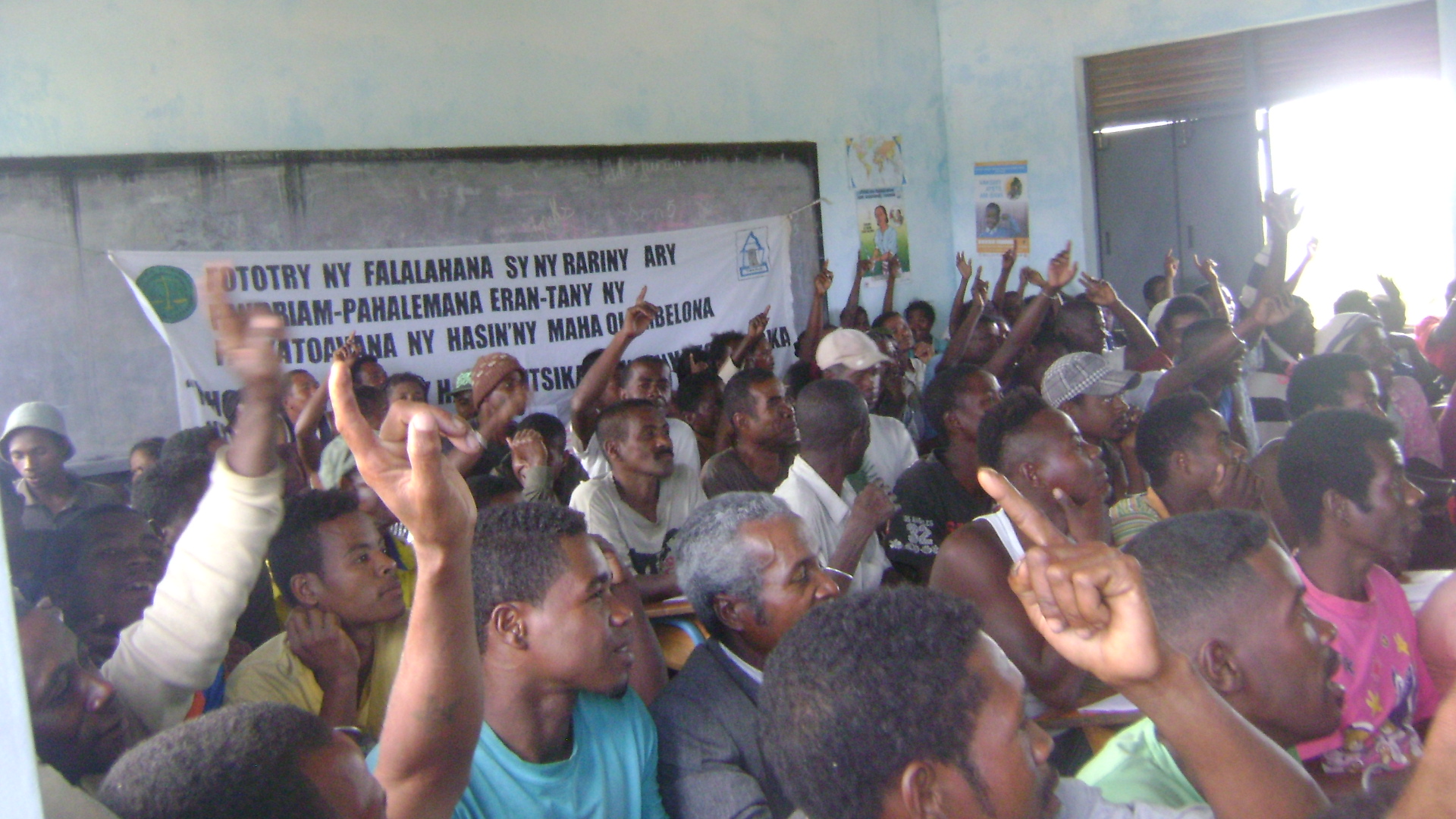
At the start of the session 134 people reported they had no understanding of their human rights; by the end of the session 135 people reported they had learnt about human rights and the related topics (Note: the Mayor had initially he said he knew about rights, but after the training expressed he had learnt new information). The community sent a letter of thanks to express their gratitude for the training . A total of 135 villagers participated, 92 men and 43 women.

In the following months, through to January 2018, TAZ assisted in a further five meetings, including with the National Environment Office (ONE), QMM and Rio Tinto officers, Asity (Birdlife International’s local affiliate) and representatives from the regional authorities and national ministries.

See table of activity: Timeline of the Antsotso Accompaniment 2017

TAZ recorded proceedings, produced written reports, and provided an independent third party presence to observe how meetings were conducted. The community received these recordings and documents as testimony for their records.

Antsotso is visited by the Office Nationale pour L’Environnement (ONE)

A range of issues emerged during these meetings including the broken promises of Asity and their destruction of fishermen’s pirogues; the lack of a formerly demarcated ‘user zone’ in the forest; and the frustration that no formal compensation package would be offered by QMM to replace the lost value of the forest to the community.

Steps Forward

Over a number of months TAZ and the local consultant supported the community to organise and record their ideas around the challenges and solutions for mitigating their losses.

In November, through participatory engagement, community members tabled a list of demands ranging from agriculture support, technical assistance, and boats (to replace pirogues) through to infrastructure and livelihoods opportunities. Although there were different views about the immediate priorities, the range of demands were captured across different groups from across the community and therefore could present a number of ways for the mining company and other funders to help improve Antsotso’s situation. The community reflected on their need to resolve internal differences and it was agreed a resolution process would be set up at community level.

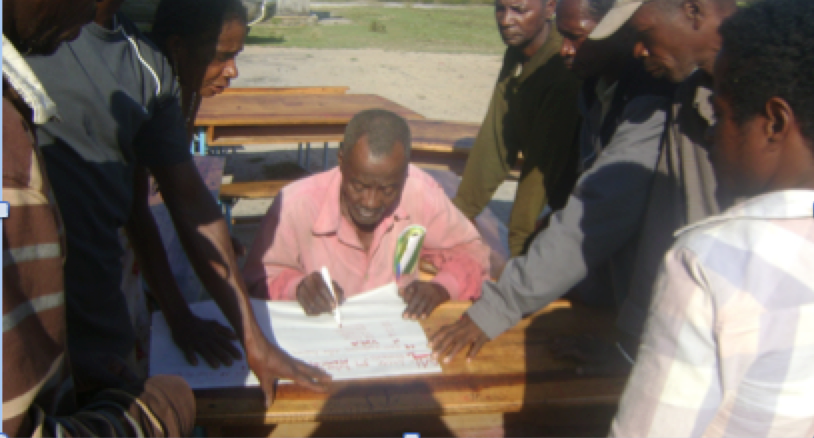
Villagers work together to identify issues and solutions

According to correspondence from the Mayor, a resolution process was conducted with community members on 21st January 2018. The following week, the community met again with QMM and Antsotso’s Mayor handed their list of demands to QMM representatives. (see english translation of Antsotso demands here)

It is understood that QMM have initially offered to set up bee keeping and pepper growing livelihoods projects. However, these will not be sufficient to replace the community’s food security. Other initiatives will need to be offered to the community during this year if food shortages are to be mitigated in the longer term.

The dialogue between QMM, the community and ONE is ongoing and there remain outstanding issues about demarcation of a ‘user zone’ and signage within the conservation area yet to be resolved.

Wider Advocacy Impacts of the Accompaniment

With the community’s permission, copies of the recordings and reports of meetings have been given by TAZ to ALT UK who has shared them with a Malagasy diaspora organisation that promotes the defense of Malagasy lands and is assisting the community with questions arising from the Biodiversity Offsetting arrangements in Antsotso.

It is hoped that TAZ’s recordings will offer insights, assist analysis and inform considerations with regard to the community’s land tenure and rights going forward.

women are under-represented in local meetings and decision making processes

Reflection and capturing lessons

This is the first time this kind of local accompaniment has been attempted with local mining affected communities in Anosy. There have been many challenges in the complex scenario. It has not been a discrete nor a complete process. Multiple actors are involved in Antsotso’s story, not all of whom are in direct communication with each other. Many interactions have occurred that may have influenced events but the details of these are not available for analysis, and some questions arising and lines of inquiry have not yet been concluded. The process of reflection and capturing lessons is therefore ongoing.

It is hoped that learning from this experience can inform future efforts to offer solidarity and support for communities who face similar challenges.

For further information please contact: info@andrewleestrust.org
[1] QIT Madagascar Minerals (QMM) is a subsidiary of Rio Tinto, an Anglo- Australian multi national mining corporation. QMM is extracting ilmenite from the southeast coastline of Madagascar in order to produce titanium dioxide, an industrial whitener used in a vast number of products from paint to toothpaste. The project is a Public Private Partnership, jointly owned by QMM 80% and the Malagasy Government 20%.

[2] ALT UK developed its  ‘Groundswell’ strategy in 2015. The strategy reflects more deeply the approach and work ALT UK has undertaken over many years, based on lessons learnt locally, including through its responsible exit from Madagascar . The Trust changed its charitable objects in 2016 to embed the current strategy and enable ALT UK to focus more specifically on capacity building for civil society actors and organisations in the global south;  to share lessons and experiences into other regions of Madagascar and beyond, promoting local leadership and ownership of development, and south-to-south exchange and accompaniment.

ALT GroundSwell  is supported by The Aldama Foundation.

Posted in Uncategorized | Leave a comment

From immediate relief to longer term food security in Androy

Last September Andry Lalana Tohana (ALT Mg) reported their activities of the  famine relief programme in Androy over a six month period from February to August.


Despite delays through administrative, logistical and cultural challenges, ALT Mg’s team were able to successfully register 1476 beneficiaries as eligible for cash transfers. They also set up 132 Committees for Social Protection (CPS) and trained 69 Mother Leaders.

1238 people received cash transfers for their families with a value of 158,880,000 Ariary and a total of 7428 family members benefitting in total ( 1238 x 6 the average family size).

Those who were eligible but had not yet received payments due to administrative problems have since been helped to receive payments. Additionally new income generating activities have been set up to provide for longer term food security.

Thanks to the support from the UK, ALT Mg has felt more able to achieve all the activities of the relief programme:

“The funds that come from you help us a lot. Many agents of the FSS* program cannot cope – the budget is not viable as there are no running costs included; but thanks to the additional funds coming from UK we have been able to accomplish all the activities of this FSS program” Hanitra Raharimanana, Director, Andry Lalana Tohana (ALT Mg).

Going Forward: Income generating activity and long-term food security

Mother Leaders of Anja Ouest

In August 2017 the team commenced income-generating activities and is now training local CPS groups in a variety of skills to increase their longer-term food security and resilience.

The groups, which are made up of the same beneficiaries registered for cash transfers, receive a ‘Fonds de Redressment” (Recovery Fund) of 180,000 AR (per person) and decide how they want to use the funds to generate income.

The ALT Mg team works with ‘Mother Leaders’ and each respective group to explain the objectives of the “Fonds de Redressment” and how this part of the funding would work; also to ascertain the Groups’ project goal/activities. The ALT Mg team were trained in animal husbandry so they can accompany and support the groups. For example, if beneficiaries decide to raise goats then the funds are used for the purchase. Then the animal is taken to the vet for vaccinations and training is received on how to care for the animals. The evolution of the training will take place over two years and results will be monitored.

The first tranche of this fund payment (90,000Ar) for beneficiaries was paid in September 2017. By  the end of the reporting year (to FID) over 1400 beneficiaries had received their ‘Fonds de Redressement’ . Most had chosen to rear goats or sheep and 1433 reported success (just 18 reported difficulty, such as lost animals). This income generating activity will help provide food stocks as well as income in the future.

ALT UK has raised additional funds for the famine relief effort, and continues to support ALT Mg as part of its strategy to strengthen local civil society with help from Aldama Foundation.


Posted in Uncategorized | Leave a comment

RELIEF FOR DROUGHT HIT COMMUNITIES IN THE ANDROY REGION, SOUTHERN MADAGASCAR

With assistance from the ALDAMA Foundation, the Andrew Lees Trust (ALT UK) has been working to develop its new strategy, which focuses support to communities and southern NGOs directly with funding and capacity building.

The Antanadroy traditionally rely on prickly pear fruits for nutrition during the annual three months hunger gap

In light of serious food insecurity for populations in Southern Madagascar following a severe drought in 2016, The Trust has committed to using Aldama Foundation funds to support its local Malagasy NGO partner, Andry Lalana Tohana (ALT MG),  in delivering vital emergency relief for famine affected communities in the Androy region.

The funds will assist ALT Mg to deliver cash transfers to drought-hit communities where families are facing severe food shortages.

Cash transfers enable families to purchase food and other essentials. This support is in keeping with ALT’s current mission and will specifically fulfil the following objectives:

  • support a vital famine relief effort for drought affected families in Androy.
  • support ALT MG’s capacity for delivering humanitarian aid in drought areas.
  • maintain ALT MG’s standing as a key local NGO specialising in food security in the south of Madagascar
  • increase capacity of ALT MG to master cash transfer processes*.

    Training of local team to do the registration of families for cash transfers

The cash transfer funds have been accorded by The World Bank in response to the Malagasy Government’s famine alert. The programme is co-ordinated by the Ministry of the Population, Social protection and the Promotion of Women (MPPSPF) and is implemented by Fonds d´Intervention pour le Développement (FID) and the National Office of Nutrition (ONN) as part of the National Community Nutrition Programme (UPNNC).

However the World Bank grant/FID programme will not cover any of the local NGO’s running /core costs while it delivers the relief programme in Androy, and which are essential for the effective implementation of the field work and the functioning of Andry Lalana Tohana during the three year project period.

The Aldama Foundation funds will therefore be used to support ALT MG’s core running costs and enable it to operate while it delivers the cash relief to affected communities. In this, Aldama funds represent co-finance to the relief effort, and capacity building support for the local NGO*.

The Severe Drought in South of Madagascar 

The Androy region suffers annual drought with up to 18 communes profoundly food insecure

This emergency programme responds to an urgent and vital need. The impacts of four years of severe drought was deepened in 2016 by the el Niño effect and the UN reports:

“1.4 million people are estimated to be food insecure in 2016/17 in Madagascar’s three southern regions of Androy, Anosy and Atsimo-Andrefana. Of these, around nearly 850,000 are acutely food insecure, meaning they are not able to meet their food needs and require urgent humanitarian assistance”.

http://www.un.org/apps/news/story.asp?NewsID=55409#.WKrBEBicbeQ

Lack of rainfall in the Androy region has resulted in an 80 percent decline in maize production last year compared with the already reduced levels of 2015. It has also affected production of cassava, another staple food in both Androy and another southern region, Atsimo-Andrefana, where cassava production dropped by approximately half. The regions of Atsimo-Andrefana, Boeny, Melaky, Betsiboka and Ihorombe have experienced a significant decline in rice production of between 25 and 60 percent. As a result of the drought, the government has declared a state of famine in the south.

https://www.theguardian.com/world/2016/oct/21/madagascar-drought-catastrophe-looms-as-850000-go-hungry-says-un.

http://www.bbc.co.uk/news/world-africa-37792356

http://video.aljazeera.com/channels/eng/videos/madagascar-drought%3A-el-nino-leaves-80-percent-of-people-hungry/4884355956001;jsessionid=1236001A9CCB47E011FED179738DD20F

Antandroy village

Prone to annual drought and food shortages, the deep south remains one of the most fragile areas of the island with more than 82% of the population living below the poverty line and facing an annual three month hunger gap. Climate change is aggravating soil erosion and deforestation and contributes to the food security challenges in the deep south and to income at household level, also to water supplies. Faced with extreme drought, the populations of the deep south are hard pressed to stabilise their livelihoods, nutrition and human capital and rebuild their assets

Andry Lalana Tohana (ALT MG) –  an Agency for Cash Transfers

Registering women for cash transfers in Amborinabo

 The ALT MG team has considerable experience working on food security programmes and in the affected communities. Consequently it has positioned itself to act as an approved agent – ‘Agence d’Enregistrement et d’Encadrement’ (AGEE) – to deliver a cash transfer programme, to assist over 8000 people, approximately 1400 families in severe crisis between 2017- 2019.

The project meets Sustainable Development Goals and provides:

(a) monetary transfer for human development program; (b) the implementation of a social protection programme (c) activities in disaster response.

Target Areas

14 sites within three communes, including: Bevitiky, Manakompy, Tanambao Tsirandrany, in the district of Bekily in the Androy region.

Beneficiaries

Mothers who regularly bring their malnourished children to the Nutrition Centre: Total 1403 mothers of families = 1403 x 6 (average household size) = 8, 418 people will benefit.

Activities of ALT MG

ALT will ensure the implementation of the following activities:

Training in Manakompy for the Committee of Social Protection (CPS)

  • Registration of eligible households (identified by National Office of Nutrition);
  • Ensure support of beneficiaries throughout the programme;
  • Ensure the training, support and the framing of the Committees of Social Protection (CPS), and Mother Leaders (ML);
  • Ensure technical follow-up of generating revenue (AGR) of beneficiary households;
  • Perform monetary transfers to beneficiaries in 14 target sites.

ALT UK has drawn up a partnership agreement with ALT MG for the transferal of the Aldama funds. ALT UK will provide ongoing mentoring and technical support as required, as well as translation and assistance with report writing to the UK donor.

*As Cash Transfers become increasingly a mechanism for emergency humanitarian aid, developing the skills and experience in this sector will position ALT Mg to be a local leader in the south for future interventions; this programme therefore represents important capacity building for the ALT MG team.

Posted in Uncategorized | Leave a comment

RESPONSIBLE EXIT – ALT participates in INTRAC study

Last year, as a result of face to face discussions and exchange  with INTRAC, Andrew Lees Trust and its local partner Andry Lalana Tohana were invited to participate in sharing the experience of the exit process that has been core to the Trust’s strategy in Madagascar.

The INTRAC study, reported in its recent newsletter in the chapter “Rethinking Partnership, exit and sustainability”  has been published by BOND, the international development network in their PPA series of reports, and is entitled ” What’s it like to be on the receiving end of exit”

Download the report here 

The study focused on perspectives of exit and transition from partners in the global south. It provides insights how in country stakeholders experience the process, and makes recommendations. ALT Mg’s perspective is important, coming from a significantly smaller local organisation than the two other well known agencies.

Hanitra and a member of the  ALT MG team arriving in Akilisoa Somangy 2 in 2017, with vehicles transferred to their ownership by ALT UK during the exit strategy (completed in 2010)

Hanitra Raharimanana is Director of Andry Lalana Tohana (ALT MG), The Trust’s local partner in Madagascar, and she provided her personal reflections on the transition process that was the focus of The Trust’s sustainability strategy leading to its exit from Madagascar, and the full hand over of assets, know how and resources to ALT’s Malagasy field team in 2010.

The exploration and understanding of responsible exit strategies, sustainability of local NGOs and civil society organisations (CSOs), and divesting power to the south is an important theme in current development discourse and ALT UK/ALT MG are delighted to be part of this research, especially its Southern perspective.

ALT MG in Vatoarivo launching their emergency relief project 2017


The Trust is currently supporting Andry Lalana Tohana as it delivers an emergency (cash transfer) programme in the Androy region, following the 2016 serious drought and famine .

Posted in Uncategorized | Leave a comment