

In Memoriam
On the 31st December 2024, The Andrew Lees Trust marked the thirtieth anniversary of Andrew Lees death in Madagascar. Andrew gave his life while seeking to protect the endangered forests and unique biodiversity of southeast Madagascar and his sacrifice and inspiration remain an enduring legacy.
Andrew’s spirit has accompanied us on the paths we have trodden. Andrew believed in speaking truth to power. He passionately defended the natural world, and he encouraged people to find and advance their own solutions to environmental, social or personal development. His scientific rigour, his integrity and tireless tenacity in seeking to expose the truth, protect the environment and champion the voiceless has echoed through our endeavours. So too has his passion for working with local people. His family, friends and colleagues are interwoven into the story of the Trust, and those who have come to work with us have embraced the atmosphere of extended ‘family’.

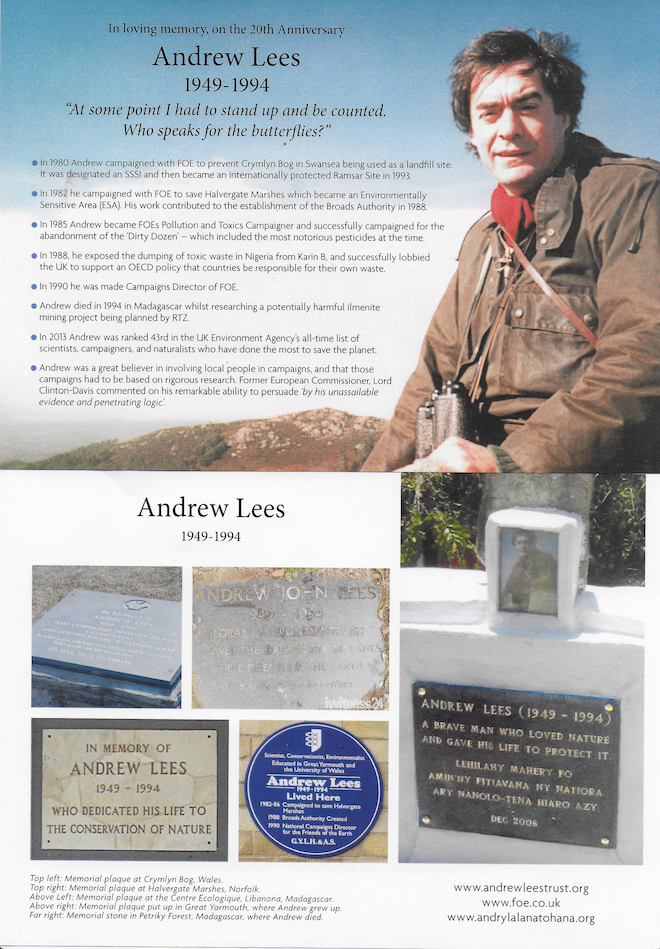
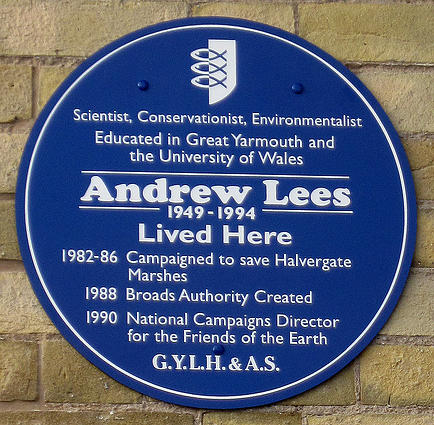
A traditional Malagasy stone marks the place where Andrew fell in Petriky, southern Madagascar, while filming its endangered forests. It is designated a sacred site by the villagers, protected under their traditional laws. Some six thousand miles away in the UK, a local government plaque marks his tenacious and inspiring work to protect the Halvergate Marshes in Norfolk, his birthplace. But wherever Andrew is remembered there is no sense of distance, just a whisper in the grass and the fluttering of butterfly wings.
“At some point I had to stand up and be counted. Who will speak for the butterflies?” Andrew Lees
Some key campaigns of Andrew Lees
In 1980 Andrew campaigned with FOE to prevent Crymlyn Bog in Swansea being used as a landfill site. It was designated an SSSI and then became an internationally protected Ramsar Site in 1993. a plaque in Wales marks his successful work to protect Crymlyn Bog.
In 1982 Andrew campaigned with Friends of the Earth to save Halvergate Marshes, which became an Environmentally Sensitive Area (ESA). His work contributed to the establishment of the Broads Authority in 1988.
In 1985 Andrew became Friends of the Earth’s Pollution and Toxics Campaigner and successfully campaigned for the abandonment of the “Dirty Dozen’, which included the most notorious pesticides at the time.
In 1988, Andrew exposed the dumping of toxic waste in Nigeria from Karin B, and successfully lobbied the UK to support an OECD policy that countries be responsible for their own waste.
In 1990 Andrew was made Campaigns Director of FOE.
Andrew died in 1994 in Madagascar whilst researching at that time a proposed, potentially harmful ilmenite mining project by mining giant Rio Tinto.
In 2013 Andrew was ranked 43rd in the UK Environment Agency’s all-time list of scientists, campaigners, and naturalists who have done the most to save the planet
Andrew in Madagascar 1994
Andrew went to Madagascar in December 1994 to research a mineral sands project proposed by the mining giant Rio Tinto. The ongoing extraction of ilmenite from these sands is projected to denude the south-eastern coastline of 6,000 hectares of littoral forest and its unique biodiversity, while also impacting thousands of villagers who depend on natural resources and these forests for their survival.
Andrew died on New Year’s Eve while filming in the forest of Petriky, one of the extraction sites just south of the Antanosy capital, Taolagnaro (also known as Ft Dauphin). A committed botanist and environmental campaigner of international renown, Andrew was researching the region to understand what locals knew of the proposed mine and was capturing their voices and images of the local environment to bring the potential issues to light.

Read the 30th anniversary article in The Ecologist HERE
Andrew was a great believer in involving local people in campaigns, and those campaigns had to be based on rigorous research.
Former European Commissioner, Lord Clinton-Davis commented on Andrew’s remarkable ability to persuade ‘by his unassailable evidence and penetrating logic”
Andrew Lees the botanist and environmental campaigner
Launch of the Andrew Lees Trust
Andrew was missing in the forest for almost a week before his body was found and eventually repatriated. After his death, colleagues at Friends of the Earth, the Lees family and Andrew’s partner Christine Orengo met to agree that the thousands of pounds donated to Friends of the Earth to help the search for Andrew be used to help set up an environmental educational centre in the region, the Centre Ecologique Libanona (CEL), which would provide higher education courses for Malagasy students.
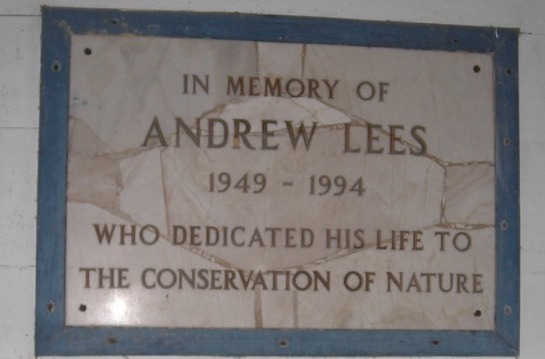
Andrew believed passionately in empowering people to fight to protect their environment. The almost scholarly rigour that Andrew brought to his campaigning was one reason the Trust supported a training centre. This could centre could offer learning opportunities to develop young Malagasy professionals to document and understand their environment and be better able to protect it.
The CEL was launched in 1995, was run by Malagasy academics, and went on to develop university accredited courses.
The Trust supported the CEL over many years with funds for infrastructure, teaching and bursaries, as well as sending library books and equipment.
In 1998 the Trust began its own social and environmental education programmes in the field in southern Madagascar, working with communities to address their needs for communications, access to non-formal education, improved food security and natural resource management. Over the following decade, the Trust’s field programme grew to encompass eight regions of southern Madagascar, reaching more than a million people across all its programmatic themes, and providing employment and professional development for 60 Malagasy staff.
Read about the Trust’s field programmes HERE
The Trust realised its strategy to support and develop the capabilities of local people, strengthening their capacity to lead and advance locally developed initiatives for social and environmental transformation. This was embodied in the hand over of all its assets and know how to its local Malagasy team in 2009 and the launch of the sovereign Malagasy NGO, Andry Lalana Tohana (ALT MG).
Responsible Exit
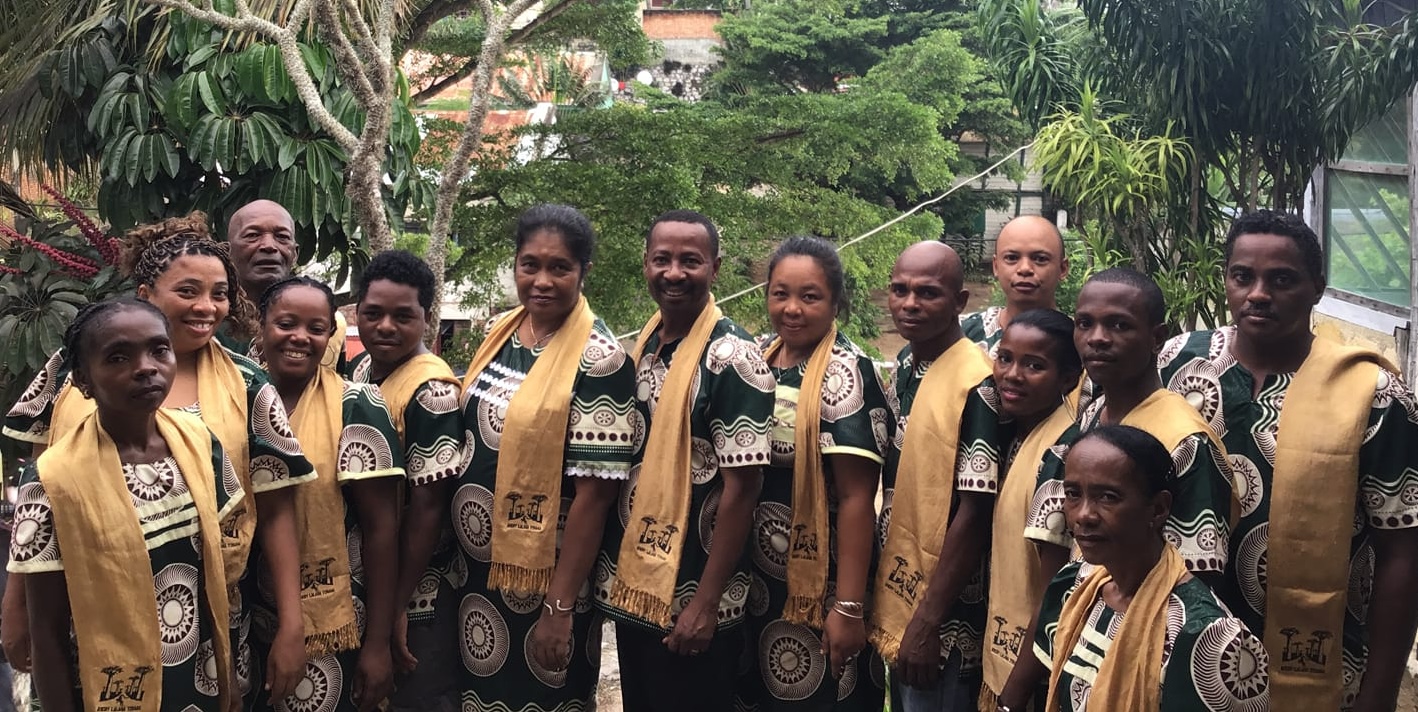
The Trust handed over to its local team in a responsible exit in 2009. The strategic preparations for hand over and sustainable management of core field programmes, including the radio project (Communications for Development) and the sorghum reintroduction programme (food security), were realised over a three year period and assisted the team to finally set up and launch their own Malagasy NGO. The Trust accompanied Andry Lalana Tohana (ALT MG) for a number of years, especially supporting the fledgling organisation during the years of political crisis 2009-2014 that immediately followed the handover and saw the collapse of national funding envelopes in Madagascar. The Trust has since maintained a policy of responsive assistance to ALT MG, for example for technical advice, fundraising and equipment.
Read about ALT MG HERE
In 2024, ALT MG celebrated 15 years of a successful track record and is an acknowledged leader in the famine relief effort in the deep south of the island, working with multiple national and international donors and partners in the affected communities. It is also a UN recognised provider of Communications for Development (C4D) in the south.
Research and Advocacy
A further area of the Trust’s work has been to amplify the voice and advocate the human rights of local communities affected by the large-scale mining.
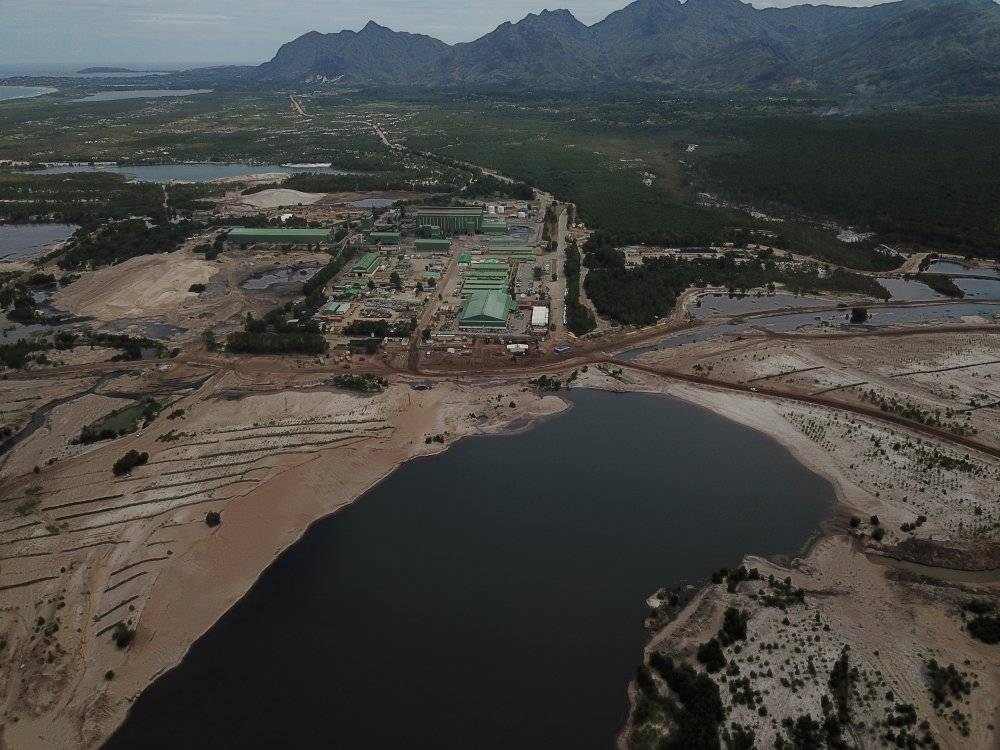
The Rio Tinto QMM mining project that Andrew researched was approved and finally started extraction in 2009. The QMM mine has brought some notable changes to the region but for the overwhelming majority of the rural communities living directly adjacent to the mine, these have not been positive.
Some 94% of the rural affected communities living around the mine reported only negative impacts of the mine in a 2022 study by Publish What You Pay Madagascar. As well as loss of lands and forest, water quality has been affected and livelihoods impacted with serious loss of revenues since the arrival of the mine, especially due to the negative impact of the mine on fish stocks and other water products (mahampy reeds) essential for survival and livelihoods.

The Trust has monitored the effects of the mine’s advance on local communities and civil society, including groundbreaking participatory communications such as the Oral Testimonies (published by PANOS London in 2009), which lead to a legal class action against the mining company around failed compensation for displaced people.
Read about the research and advocacy work HERE
Andrew foresaw the challenges local people would face to protect their natural environment and traditional lifestyles around the mining operation. Throughout his career, he championed the use of both scientific research and law in environmental protection.
The Trust has undertaken substantive research from 2016 following the mine’s breach of an environmental buffer zone designated to protect local waterways. The breach led to concerns about water contamination from uranium, lead and other heavy metals, which are concentrated during the mine’s extraction process and are present in mine process water that is discharged into the local environment.
Read more about the mine and local communities HERE
The research has involved significant inputs and analysis from international scientific experts in radioactivity and hydrology as well as close collaboration and exchange with Malagasy civil society locally, nationally, and in the Diaspora. The advocacy has resulted in some technical changes, new investments into the mine, and greater financial commitments to the social programme for local communities. The issues are ongoing.
This research has also been instrumental in aiding the launch of another legal case against Rio Tinto by the UK human rights law firm Leigh Day, which is pursuing damages for local people with regard to concerning levels of lead in their blood, which local people claim is attributable to the mine’s contamination of their natural drinking water sources.
Read about the legal case HERE
The Trust endeavours through its research and advocacy work and its partnership with Malagasy civil society, to honour Andrew’s legacy and promote human rights, transparency and accountability for mine-affected communities in southern Madagascar. Its approach is grounded in decades of experience of working within the southern context, and understanding and appreciating its particular social, cultural and environmental character, strengths and challenges.